All posts by Elizabeth Hibbett Webb

My aim is to publish, in date order, the letters my father, Private Bertie Hibbett, wrote home to Walsall, almost twice a week, from 1914 – 1918. His self-styled ‘humble scribblings’ give a vivid picture of what it was like to be a Private in Kitchener’s Army but, with their original drawings, sketches and photographs, they provide an important collection of primary source material for social historians in this centenary year of the outbreak of the Great War. As a child I was more aware of the 1st World War than of the 2nd, through which I grew up. My father was Vicar of St Vedast’s Church, Tathwell, Lincolnshire and I was never allowed to forget that my birthday was also St Vedast’s Day, for this was an ever present reminder to him of his dawn sentry duty on Easter Day 1915, at Neuville St. Vaast, Messines. * Like my grandfather, Arthur Hibbett, Chief Inspector of Schools for the Borough of Walsall, my career has been in education; mainly in higher and further education, where I taught courses in historical and literary interpretation & methodology. I have a BA Hons.degree in Theology and History from the University of Nottingham and a Master’s degree in Hermeneutics from the University of Bristol. My first teaching post was at Luton High School, then I became Lecturer & Senior Lecturer in Theology and Religious Studies at the College of St Matthias, Fishponds, teaching the University of Bristol, B.Ed. degree. After my marriage, in 1971, to David Kester Webb (painter, photographer and teacher), I became the first Open University Tutor Counsellor and Associate Lecturer in North Devon, from 1974 until 2000. During that time I also taught Religious Studies ‘A’ level at North Devon College. Kester and I published our book, The Hidden Edge of Exmoor,in 2011 (www.thematic-trails.org). This is the story of our life-time’s climbing exploration of the Exmoor Coast at Sea-level; literally hands on geology. We have two offspring: Rebekah (Consultant in International Development: Gender/HIV/Aids) and Martin Vedast, (Project Manager in Ceramics for Disabled Adults). * NB The name Vedast or Vaast means Foster in English. St Vedast was a 4th C. saint, patron of numerous churches in N. Europe, chiefly of Arras Cathedral. Apart from St Vedast Tathwell, the only other church in the Uk with this patronage is St Vedast, Foster Lane London.

3rd SEPT.1916: EARL SOHAM’S WAR-TIME HARVEST, SUFFOLK.

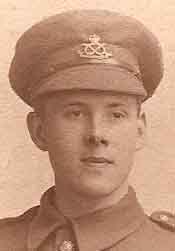
Basil Hibbett Age 18. 1916.
Basil Hibbett. 18 yrs. 1916.

BASIL HIBBETT, Earl Soham, Suffolk: LETTER to BERTIE, The Cenacle Red Cross Hospital, New Brighton, Cheshire. 

Earl Soham (1).

Sunday (3rd September? 1916) (2).

My dear old Bertie,
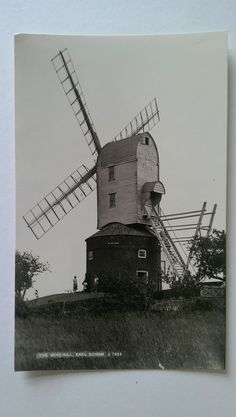
uk.pinterest.com Windmill Earl Soham PC 1930sce350ef7e3d08a512e2cea888ec76114
Earl Soham Windmill, Suffolk.
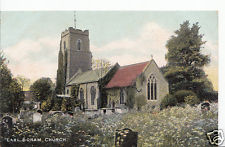
Earl Soham Church, Suffolk.
St Mary’s Church, Earl Soham. c  AD 1320.

Many thanks for the letter received last week: am sorry I have not written before but you know how we stand in a tiny village with an orange-box for a Post- Office! 

I rushed off down the village on Thursday just after dinner to buy a few Post cards and Stamps and found every place closed including the Orange Box, otherwise known as P. Office.

I was very sorry that the photo was spoilt; it has been fingered such a lot you see! Never mind I want it if you don’t: I haven’t one of either of you now and I don’t like it not ’arf!  Hope H(arold) has sent you some by this time.
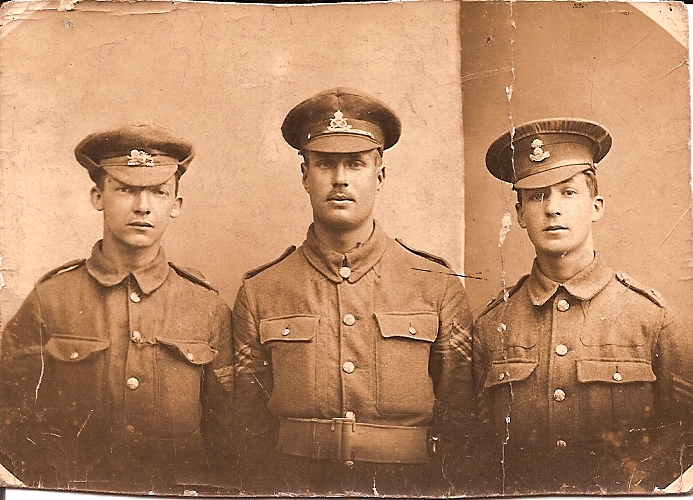
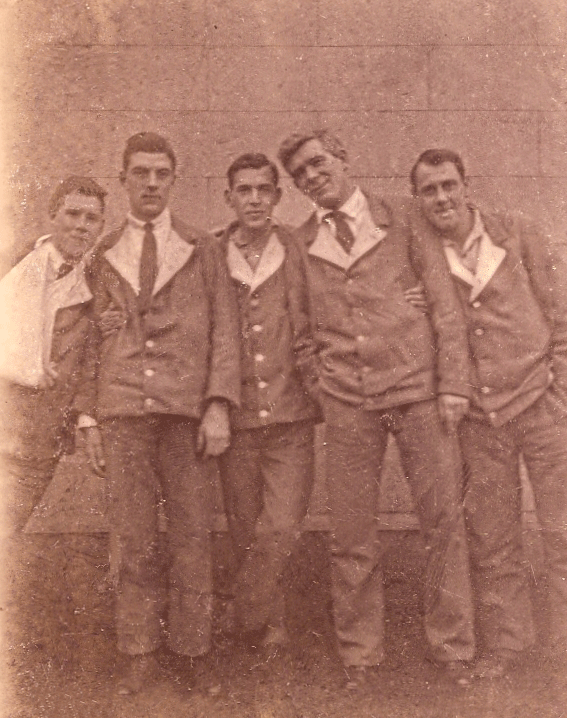
Centre: Sydney Hibbett. Sergt Training.1916. Does anyone recognise the other soldiers.
Centre: Sydney Hibbett. Derby 1916. Who are the other new Serjeants?  See Hibbett Letters:

Where did you get the photos of S. taken with the Reserves at Derby? (3).

I guess you will be glad to hear that H. is going to see you for a few days. 

I am glad also for your sake as I expect you do get fed up now and again. How long do you think you will be there?
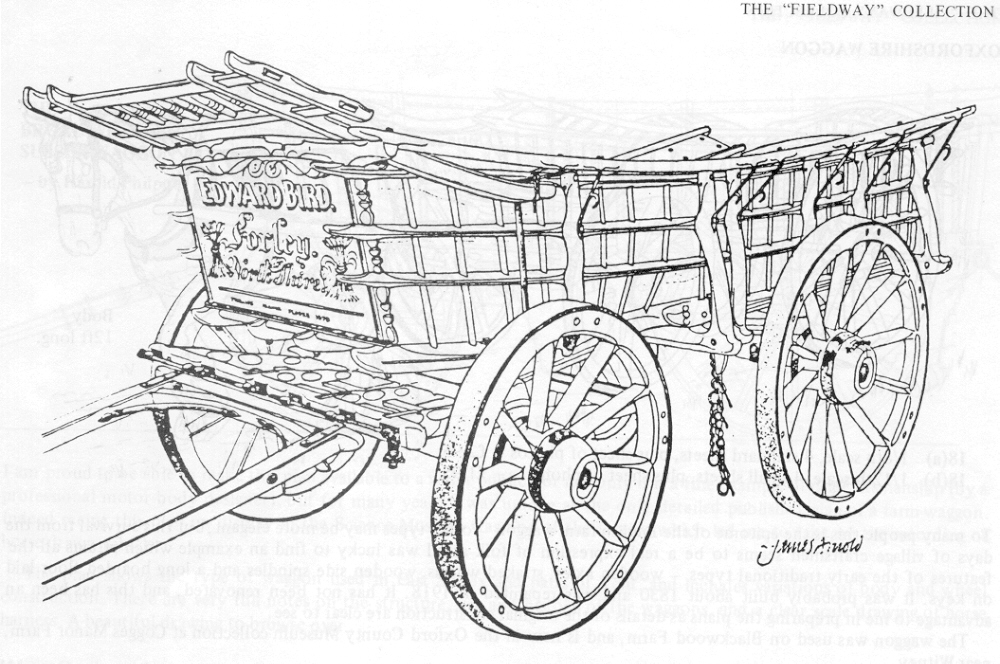
Northamptonshire Farm Wagon.
Northamptonshire Farm Wagon. <www.welney.org>

Yes, we are busy as you say, especially as the harvest is late (more than a month) and as we are so short handed. 

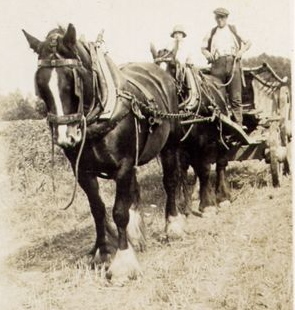
We have started to cart the wheat & oats. I am the carter!  I find it quite exciting at times with a big load on. There is a ditch between two fields which has to be crossed thru. a gap in the hedge. We filled in the ditch with hedgings & straw, but it did not seem very firm as I came across with a great towering load of wheat!  I thought the bally show was coming on top of me as it sank into the bed of straw and then bumped onto the other side. 
www.welney.org.uk
Clydesdale Horses? Early 20th Cent.<www.welney.org.uk

And of course there is the nag to look after & shout & yell at.  There is one horse, a grey mare, that doesn’t require any of that & it doesn’t look at the ditch, but simply charges off over, and I have to charge along-side it with the load bumping & rolling at the back!  O them ’osses!

Rabbit in wheat field.
Rabit in a wheat field: <www.permuted.org.uk>

It is very exciting when we have been cutting some wheat or oats and there is a small piece left to be cut. 

We all arm ourselves with thick sticks & get ready for the fray. 

Out come the rabbits, or rather they don’t come out this year somehow, but anyway when they do there’s plenty of fun. There have not been so many this year & we have only caught 12 all the time I have been  here: the men generally take a few. If we have got a lot, say a dozen at once, I will try to send a few to your Hospital.  I should like to send something. The apples are hardly ripe yet.  Would you like some when they are?

I went round this afternoon finding eggs, the hens stray all over and lay just where they like. I found three eggs in a nest by the roadside and also 2 guinea fowl eggs.  Mrs. Adams (4) has forty hens, about thirty chickens and a flock of geese, about 35 in number.  Unfortunately all the hens aren’t laying and we don’t get many eggs. 

All the milk from the 3 cows goes to butter making, of which we get 30 lbs a week.  Mrs. Adams sells it to the people at Ipswich, except that which we use ourselves. There are some very nice calves and a pair in particular.  This particular pair is quite swanky & look at me, as I get over the style, just as though they were in the Stalls and I was in the Pit.   

I am feeding enormously! – fat ‘bearcon’ in particular, plenty of cheese, butter, beans, potatoes, onions & meat!

Now with regard to Sydney, that is quite a good idea of Miss Foster’s which we are adopting (5). I think we are getting a little ‘nearer’ to him, don’t you?  We must keep pegging away at making enquiries & keep on smiling. 

Must close now dear old boy & I hope you will have a good time with Harold. I am sure you will.

With best love from

Dodger.

PS Mr & Mrs Adams* send their best wishes & hope you make a good recovery.

**********************

ELIZABETH HIBBETT WEBB

A Good Harvest in 1916 was critical. It was reported that the country’s wheat supply was down to six weeks owing to German attacks on shipping  in the North Sea & Atlantic. Farmers were given a guaranteed price for wheat & oats and Food Rationing  became compulsory. 

It is no wonder that Basil Hibbett, with his interest in farming, was not called up immediately he attested – but it is not clear whether he was now complying with government requests for help with the harvest in Suffolk. It is possible there were family connexions on the East Coast.  Grandfather Henry Hibbett, was born in Empringham, Rutland, 1824, into a farming family going back generations, before he became a master plumber & glazier in York. The Hibbett Family frequently holidayed at Uffington in Rutland. 
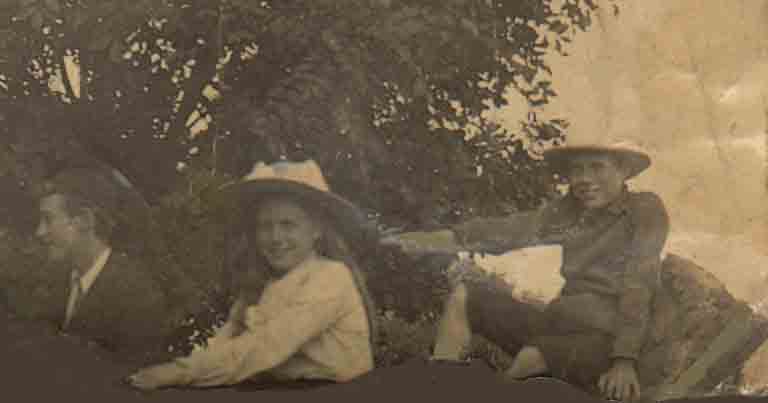
Ida and Sydney. On holiday with cousins at Uffington.
A Hibbett cousin with Ida & Sydney, (riding on Uncle Sell’s farm-cart?), Uffington, Rutland. c 1905.

(1) Earl Soham, Suffolk (two miles west of North Framlingham): An Ancient Roman Settlement, so called after the Earls of Norfolk (Bigod family).  15 miles from Ipswich on the River Orwell & Estuary. 

(2) No Date given: it could be a Sunday in August but 3rd Sept. best fits details in the letter re Bertie’s request for Harold’s photos & mention of ‘a late harvest’. (Spring wheat harvest was usually late summer/early autumn).

 (3) Sydney Hibbett was sent Home from the Front with catarrhal jaundice in early 1916. From Hospital in Cirencester he was transferred to Staffordshire Regiment Reserves in Derby, where it appears he began Serjeant training. See Hibbett Letters: 10th Jan.1916.

(4) Mrs Adams: Basil’s landlady.  According to Genes Re-united there was a B.F.Adams living at Cheshunt? Farm, Earl Soham in 1914 – advertising his cabbage plants for cattle, cooking potatoes and marrowfat peas in the local paper that year. The Adams’ Farm appears to have been mainly arable with just a few cows & the usual poultry. 

(5) Mary Foster: another example of the help Bertie’s Godmother was giving the family – letter writing all-round in the search for Sydney

NEXT POST: 19th Sept. 1916. ‘What makes you think about barbed wire now?’ Your Old Pal Ben.
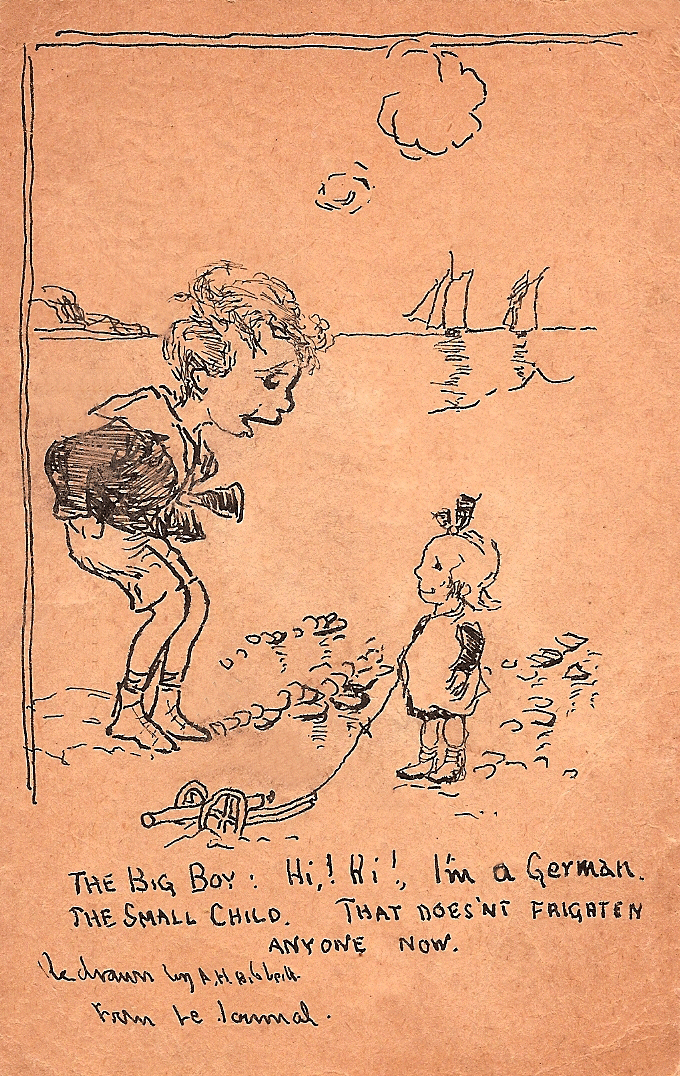
30TH AUG. 1916: LE JOURNAL CARTOON ‘GERMAN BIG BOY & SMALL FRENCH CHILD’.

Bertie in UniformPte BERTIE HIBBETT, The Cenacle, Red Cross Hospital, New Brighton. CARTOON POST CARD to Arthur HIBBETT, 95 Foden  Rd Walsall.

                       The Cenacle.     30/8/16. 


Copy of Le Journal Cartoon
A.H.Hibbett’s Copy of Le Journal Cartoon. Posted Home 30/8/16. (NB Double Click to enlarge).

Received Mother’s letter yesterday & PC this morning. 

I will write to the Quartermaster today about Sydney’s things (1).

Could Basil develop some more photos that Harold took and bring some when Mother comes (2) also one or two white soft collars. 


I am as usual.   Best love,  Bertie.

********************

ELIZABETH HIBBETT WEBB

The optimistic tone of this French Cartoon suggests a date of publication during the long weary months of the Battle of the Somme when, with the enormous loss of young men in France, there was a felt need to raise the nation’s morale and hope of victory.   

Drawn with his left-hand my father’s copy of The Le Journal Cartoon reads: ‘The Big Boy: Hi! Hi! I’m a German.  The Small Child: That doesn’t frighten anyone now’. ‘Re-drawn by A.H.Hibbett. From Le Journal‘. (French daily newspaper founded & edited by Fernand Arthur Pierre Xau 1892-1899, then by Henri Letellier. Closed 1944).

(1) Quartermaster in 1/5th Bn South Staffords: A Quartermaster was a senior NCO responsible for supervision & distribution of food, clothing & equipment. Sydney’s last letter before the 1st July Battle of Somme, entrusted his belongings to his pal CorpA.O.Jones. Hibbett Letter. 28th June, 1916. 

Matron, nurses & patients at The Cenacle.1916.
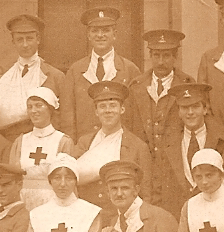
Matron Gertrude Bellow (centre), Sister  M. Clive (dark belt), Nurses & Wounded Soldiers at The Cenacle.  Pte Bertie Hibbett  (seated right, arm in sling). Photo: Harold Hibbett. Autumn ,1916.

(2) Photographs of The Cenacle Nurses & Wounded Soldiers: Basil Hibbett no doubt developed extra copies of Harold’s photos in the Top Attic at 95, Foden Rd. Walsall. (NB A Names List of Cenacle Red Cross Nurses mentioned in my father’s Letters & Papers, as well as of fellow Patients, is pending).

NEXT POST: 3rd SEPT.1916. Basil Hibbett & the Harvest at Earl Soham, Suffolk, 1916.

28TH AUG.1916: ‘BE THOU FAITHFUL UNTO THE END & I WILL GIVE YOU A CROWN OF LIFE’.

Bertie in UniformPte BERTIE HIBBETT, The Cenacle, Red Cross Hospital, New Brighton, Cheshire: LETTER to Arthur & Marie Neal HIBBETT, 95, Foden Rd. Walsall.

Aug. 28th/ 16.

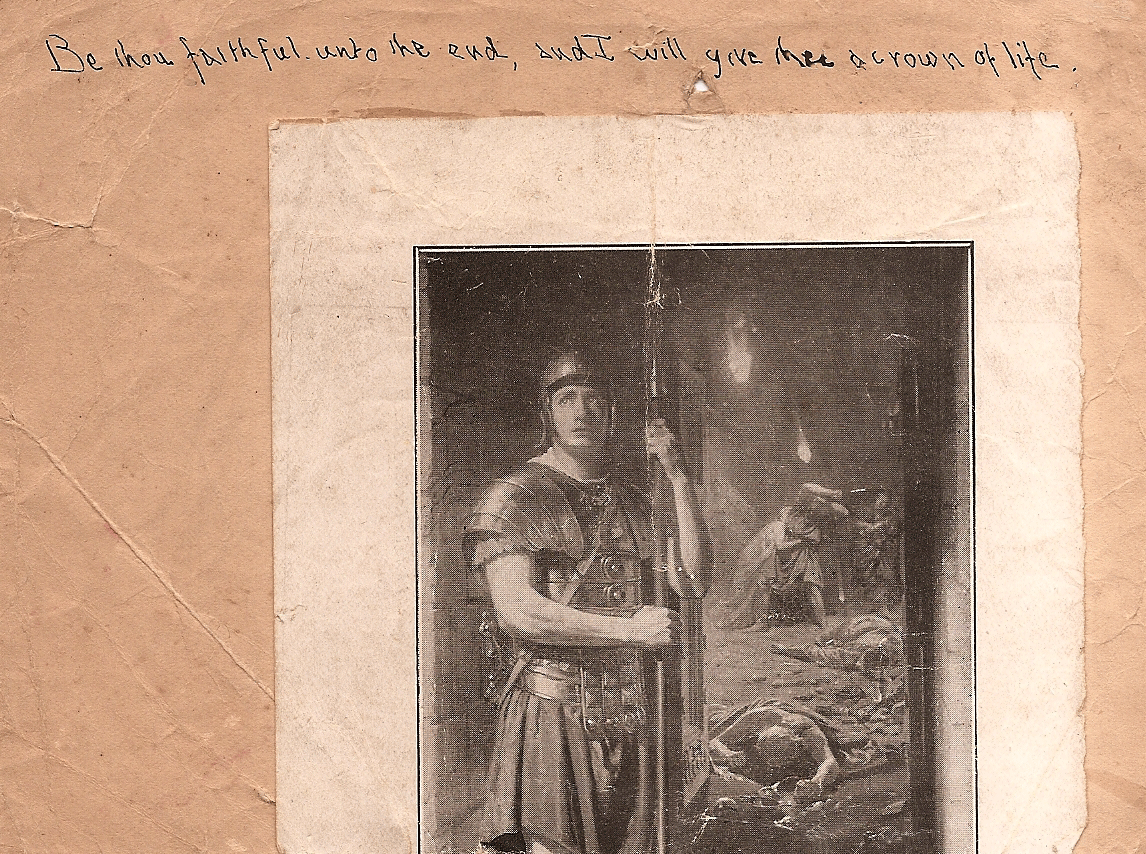
‘Be thou faithful unto the end, and I will give thee a crown of life’. (1)

Roman Soldier Ponpei
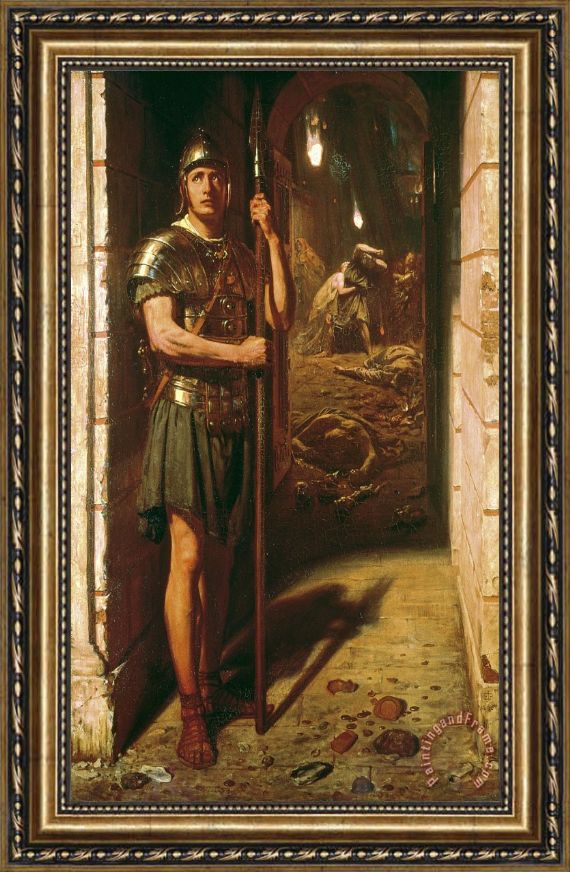
‘Faithful unto Death’. Roman Soldier at Pompeii. Eruption of Mount Vesuvius. 1865. Edward John Poynter. 1836 -1919. 

If I am not far wrong it is the eventful day of Basil being called up for Service. The picture and the words I got  from the Calendar (2) for Sat. 26th are most appropriate.

BASIL HIBBETT
BASIL HIBBETT

May Our Heavenly Father bless, protect and prosper him, and strengthen the patience combined with love in my dear brave Mother; as for Daddie, Proverbs teaches us a beautiful saying, that the glory of children are their father sic, ‘how venerable is a father in the sight of his son who has returned from the wars’ (3).

Well Miss Foster*, Mary, gets over me, I had another nice letter from her today, she takes away my sorrow. . .

(end missing).

Bertie.

****************************

ELIZABETH HIBBETT WEBB
Basil-with-cane
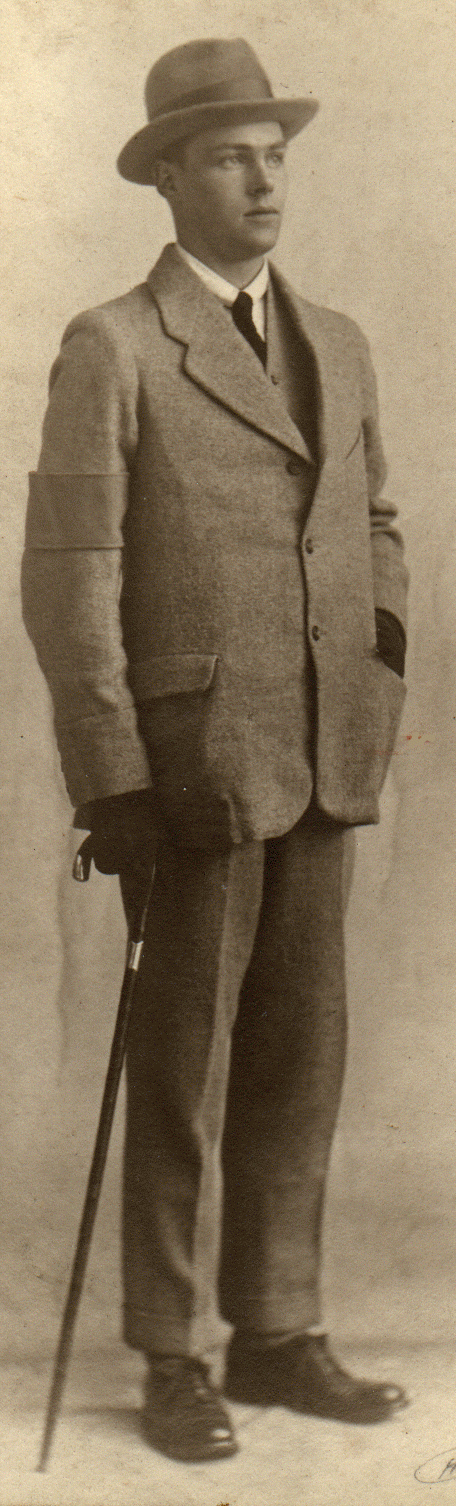
Basil Hibbett with grey arm band. 1916.

The National Registration Act of July 1915 was intended to boost voluntary enlistment. It failed. The census (in which Ida Hibbett played her part in Walsall Town Hall) revealed that 5 million males of military age were not in the forces and 1.6 million were ‘starred’ (i.e. protected by high or scarce skilled jobs). See Hibbett Letter: 21st Oct.1915.

Since the South Staffords embarked for France in 1915, Basil Hibbett had been keen to join his brothers at the Front but they had done their best to dissuade him from attesting until he was compelled to do so. See Hibbett Letter: 28 April 1916.

Courtesy Mike peters, military historian. East Anglian Daily Times 18th Jan 2016.
Courtesy Mike Peters, military historian. East Anglian Daily Times 18th Jan 2016.

The Military Service Act, 27th Jan 1916, of necessity, introduced conscription for men aged between 19 -41 years  – so Basil had no choice but to attest after his 18th Birthday (1st May 1916). According to The Long Long Trail website these ‘Class A’ men were given a day’s pay, transferred to Section B Army Reserve & sent back home until they received their ‘call up’ papers. 

Bertie states that Basil was to be ‘called-up’ on 28th Aug., but he must have meant ‘attest’ for in September Basil wrote to him about bringing in a ‘late harvest’ at East Soham, Suffolk.

www,northdevonww1stories.files.wordpress.comimages
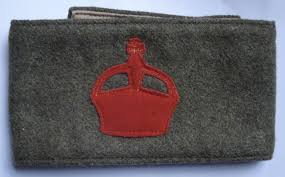
Lord Derby Scheme Arm Band with Red Crown.

Basil Hibbett was given  a grey armband with a red crown as a sign that he had volunteered. The biblical significance of the crown on the arm band was not lost on Bertie.

(1) Revelation 2.10. Exact wording KJV Bible: ‘Be thou faithful unto death & I will give thee a crown of life’.

Painting Edward john Pointer. Pre-raphaelite.
Faithful unto Death’. Edward John Poynter. Pre-Raphaelite Painter.

(2) Painting‘Faithful unto Death’. Roman Sentry at Pompeii. Eruption of Vesuvius, AD 79. Edward John Poynter, Pre-Raphaelite Painter. 1836-1919. Copy cut from Walsall Parish Church Calendar?). See ‘Pompeii Live from the British Museum’.<http://www.britishmuseum.org> 

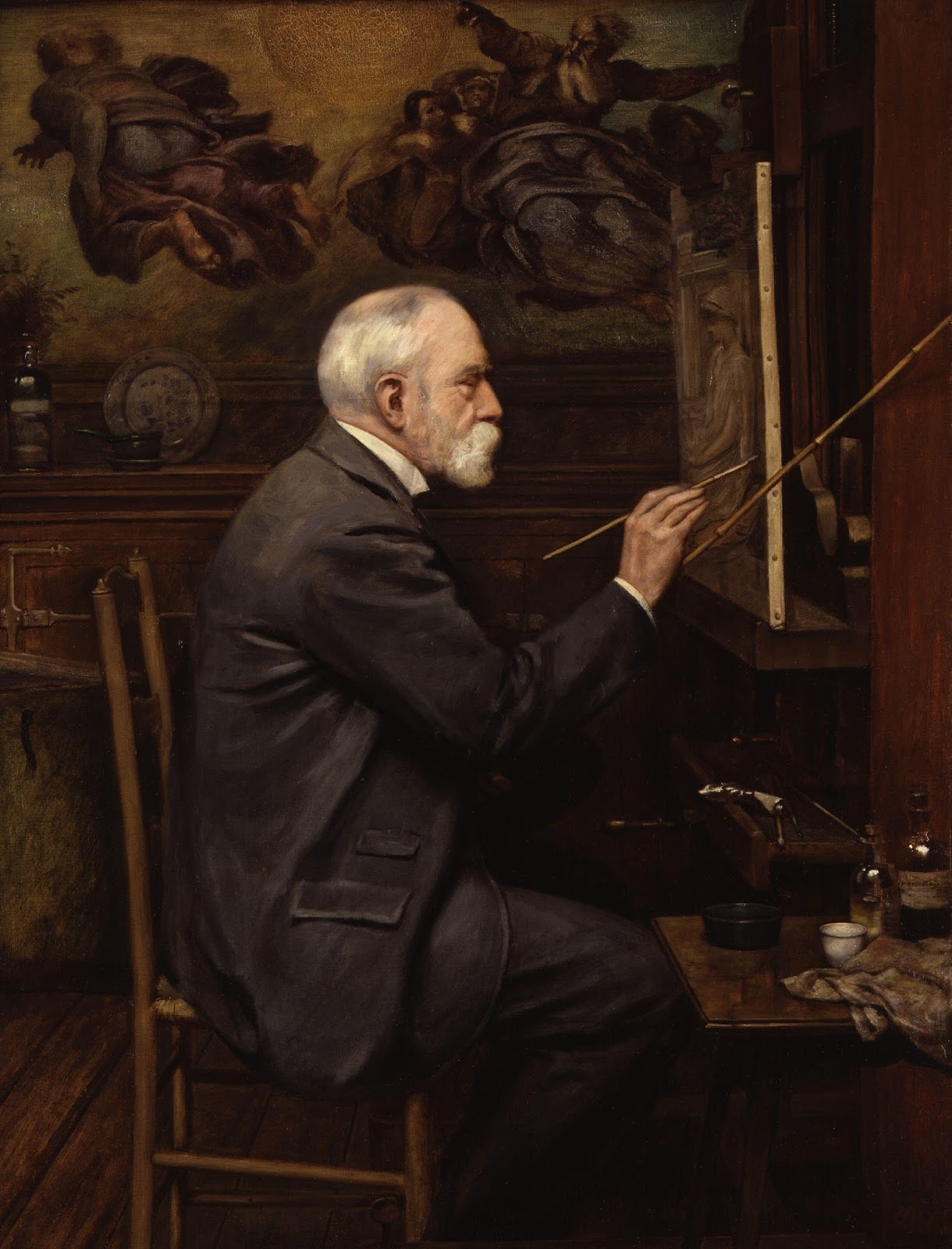
Edward John Poynter.
Portrait of Edward John Poynter.  Edward Burne Jones.1833-1898.
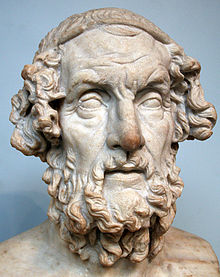
Homer
Homer. 850 BC.

(3) Proverbs 17.6: Children’s children are the crown of old men; & the glory of children is their fathers’. Second half of quotation ‘how venerable is a father’ not found in Proverbs (possibly paraphrase of saying in Homer’s Iliad?  Homer: 8th Cent BC. considered first & greatest of Greek epic poets, foundation of European Literature.

NEXT POST: 30th Aug.1916. Le Journal Cartoon.

25th AUG.1916:’MANY A TIME HAVE I THOUGHT OF YOU & THOSE OLD BOYS OF MINE MARCHING AWAY TO DO YOUR DUTY’.

CHARLES LE BON, Headmaster, Blue Coat School Walsall (?):  LETTER to BERTIE HIBBETT, The Cenacle, Red Cross Hospital, New Brighton, Cheshire.                                                                                                                                                                                                   82, Charlotte St. Walsall (1)

                                                                               Aug 25th 1916.

My Dear Bertie,

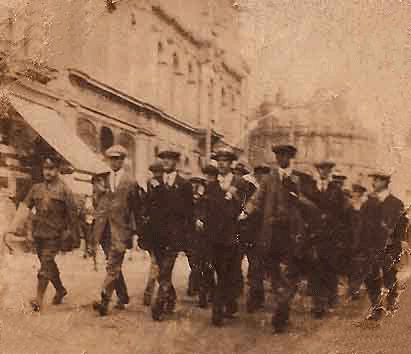
Many  and many a time have I thought of you and the other gallant lads that I watched walk up Park St. one day in September 1914.

Pte Bertie Hibbett is marching behind his brother Sydney (in mufti, front row far left). Bridge Street, Walsall. Sept. 1914.
Pte Bertie Hibbett marching behind his brother Sydney (in mufti, front row far left). Bridge Street, Walsall. 4th Sept. 1914.

There you all were in mufti marching away to do your duty and to respond to your country’s call for men. Those were the days before Lord Derby’s Scheme (2) and prior to the Military Act (3) when all of the proper age are compelled to serve. 
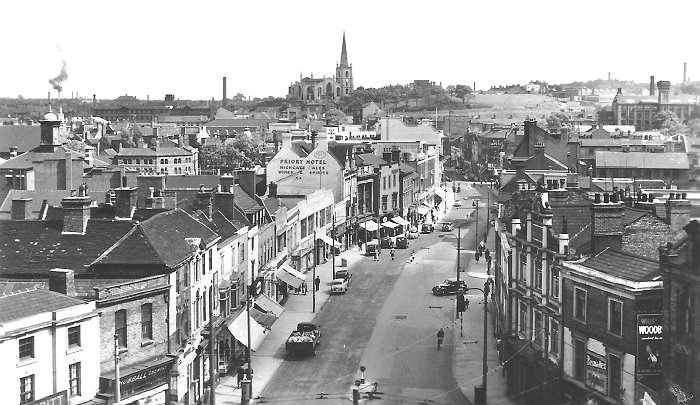
Park Street with St Matthews' Church on the hill. Christine 7 John Ashmore. Old PC.
Park Street, Walsall, looking towards the Bridge with St Matthews’ Parish Church on the hill. Courtesy Christine & John Ashmore. 1950s PC. <http://www.historywebsite.co.uk&gt;

What England owes to those men who joined up in the first month of the war none can ever tell, and words fail me when I wish to express my admiration and feeling towards those numerous old boys of mine who responded so early. 

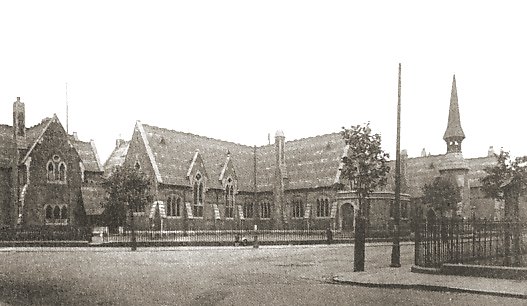
Blue Coats School Walsall. c 1914.
Blue Coats School, 1859 Building, St Paul’s Close. Closed 1933 to become Bus Station.


You know better than I do what it has meant to you allHow you sacrificed your homes, your positions, your comfort and everything that one should hold dear in this world.  I do not differentiate between any of you; all were noble, self-sacrificing gallant lads, and I am proud that you were amongst the number.
Don’t think that I ever doubted you. I know your noble nature too well, and if I wrote all I think of you I may be accused of being a fulsome flatterer and lacking in sincerity. I feel that you know me well enough to write what I mean.

Since you have been on Active Service I have made regular and frequent enquiries concerning your welfare, and when I heard  that you had been wounded I was deeply grieved for yourself and the other members of your family.  I have made numerous enquiries concerning your progress, but I forbore going to your parents because I felt that to talk about you would only increase their worry.

I am pleased to know that you are making fairly good progress, and I sincerely trust and pray that such may continue and that in the fullness of God’s blessings you may ultimately be restored to your parents safe and sound. I was highly delighted to learn of the great patience and fortitude you have shown in the hour of your great misfortune and I feel sure that such manly conduct will meet with its just reward.

We all take comfort in the worn out saying that things may have been much worse. It appears to me very cold comfort, but then we must try and be philosophic, and with brave hearts and cool courage fight against misfortunes and troubles, and with God’s help prove ourselves superior to the multitude of worries that surround us, and appear to be overwhelming us.

My Dear Bertie, I am writing with the hope that this expression of my sympathy towards you will in some small way help you to bear your great burden, and will also afford you some comfort in your illness, and perhaps the knowledge that what you have done is fully appreciated, by us who are left at home, will also assist you and comfort you.

Mrs Le Bon heartily joins with me and wishes to be remembered very kindly to you and I will close with our sincere best wishes for your welfare and fond remembrances of a brave and noble boy. 

Believe me to remain,

Very Sincerely Yours,        Charles Le Bon.

*****************************

ELIZABETH HIBBETT WEBB

The overwhelming impact of the Battle of the Somme on those at Home, and the respect & affectionate regard shown towards all who had volunteered in 1914 is clear in this letter. 

From the style of writing, as well as the reference to ‘those numerous old boys of mine’, the writer appears to be a teacher, possibly at Queen Mary’s Grammar School, but  more likely Charles Le Bon was the Head Master of the Blue Coat Elementary School in  Walsall. Sydney, Bertie & Basil Hibbett all attended this school before attending the Grammar School.

(1) Charlotte Street: the next street to the Hibbett Family Home, 95 Foden Road., a popular professional middle-class area in Walsall, close to the Arboretum.

Lord Derby 1865-
Lord Derby 1865-1948.

(2Lord Derby: Secretary of State for War 1916-1918. ‘Lord Derby’s Scheme’: The National Registration Act for Military Service was initiated by Lord Derby, & passed on 15th July 1915. It required all men, between the age of 18 and 65 years, to register their residential location on 15th Aug.1915. See: <http://http://www.1914-1918.net/derbyscheme&gt; and <http://www.firstworldwar.com/atoz/derbyscheme.htm&gt;.

(3The National Registration Act resulted from the huge number of trench warfare casualties 1915. See Hibbett Letter, 21st Oct. 1915. Ida Hibbett volunteered at Walsall Town Hall, helping to create a Card Index of Men Available for Military Service. 29 million forms were issued: Granite Blue forms for Men and White forms for Women. A Pink Form was completed for each Granite Blue Form, if that man was between the age of 18 and 41 years. Local Recruiting Officers began canvassing but the hoped-for recruits did not materialise. The Military Service Act, amounting to conscription, was then passed on 27th Jan. 1916. Basil Hibbett, just 18, the youngest of the family, had now no choice but to attest and await call up.

NEXT POST: 28th Aug. 1916. ‘Be thou faithful unto death’.

17th AUG. 1916: ‘YOU WERE ALWAYS A GOOD SOLDIER & ONE OF THE BEST’.

South Staffordshire BadgeePLATOON SERJEANT W. PRICE: LETTER to Pte BERTIE HIBBETT at The Cenacle, New Brighton, Cheshire.

Same Address (1).     17/ 8/ 16.

Dear Bertie,

Received your letter & parcel this afternoon & P.C. yesterday.  Glad to hear your comfortably settled and hope your wound will make a good cure, but not too speedy a one.

It is very  good of you to  think of us here, it is usually the case for those who are fortunate enough to get back to Blighty to forget those left behind, but there is at least one who remembers and I thank you for it on behalf of the boys and myself.  At present I am on a course away from the Batt. but expect to rejoin in a few days, probably Sunday, so will take the cigarettes, etc. with me.

I sincerely hope your brother is at the Base Hospital (2). I explained as well as I could in my letter to Miss Foster*, although I had no idea where he was until I had your letter.  Please God all is well with him and that he will make a good recovery.

I didn’t have anyone killed, the day you were wounded, in the platoon, but one man is missing. I haven’t heard anything of him yet, that was the man who put his field dressing on you, A.V. (3).Yes Gurley* & the boys are all keeping well. I don’t know Ball* but will let you know soon.  I don’t know how the other three instructors got on.

No wonder you say you are happy, what with your people being near you and the weather and the place  – you could not well be otherwise.  I hope the only shadow that is marring your happiness will soon be dispelled.

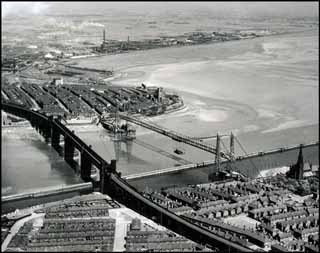
www.liverpool-genealogy.org.ukTransporter Oct 1947
Runcorn-Widnes Railway and Transporter Bridge over the River Mersey. 1905 – 1961 as Serj. W. Price would know it.

You know my home is not far from New Brighton.  Widnes,  the other [side] the Mersey from Runcorn, is where I live (4).  

I know all around New Brighton, Seacombe, Wallasey etc. quite well. 

I could envy you if you had not richly deserved your rest. As you say war seems far distant from such surroundings. 

No we have not been in a charge since you left us. I will answer for it that correspondence is kept up between the platoon & yourself.  I will write occasionally, if it is only a note it will act as a connecting file so we shall not lose touch.

Yes I wish the boys could be with you to enjoy the privileges of the hospitality shown to us all by those at home. You know I can speak from experience as I was in hospital five months. You made my mouth water speaking of chicken etc, but we are out here for a purpose, let us get this done then we will think of the luxuries of life. 

Yes Randle* found his way alright.  I cannot tell you anything about the roll call, you must guess that (5). I will tell Bird (6 ) what you asked me to.

Don’t think you were scoffed at for living as He would have us all live, far from it.  We all admire you for the strength of will you exercised to do so, and I greatly admire you for the (card?) incident.  I used to ‘say things’ myself at times, but you must remember I was a Platoon Sergeant. Still I always tried to live as I should live.

Before I close, Bertie, I should like to say that what I said in my two letters to Miss Foster* was quite true, and you must not underestimate your own qualities as a soldier. I am always candid in my opinion of everyone and I can honestly say you were always a good soldier and one of the best. 

Please accept the kindest regards of all the platoon and myself.

Yours sincerely,

Serg. W. Price.

PS. Your card enclosed.

***************************

ELIZABETH HIBBETT WEBB

The Hibbett Family was hoping against hope that the verbal report Pte Bertie had received of Sydney’s death was not true and that he might be lying injured somewhere in a Hospital in France.

This Letter indicates the lengths Bertie’s Platoon Serjeant W. Price went to help families & friends as they tried to discover the whereabouts of their loved ones. He had already written twice in reply to Mary Foster, Bertie’s Godmother, and here he promises to keep fully in touch with Bertie. His relationship with my father is yet further evidence of the respect and understanding which existed between officers, NCOs & men of 1/5th S. Staffords who volunteered in Walsall, August 1914.

WW1 Historian Peter Barton, in a recent authoritative & well documented TV series, suggests that the Battle of The Somme did not end on November 18th 1916 but continued until the following February 1917; when the Germans made a strategic retreat to the Seigfried/Hindenburg Line. <www.the guardian.com>19th July 2016, review of revised 2006 Somme Panorama.

NO MAN'S LAND, CEMETERY FONQUEVILLERS:  WOODEN CROSS inscribed: " Unknown Sergeant, S. Stafford". Photo: Basil Hibbett 1920.
WOODEN CROSS inscribed: ” Unknown Sergeant, S. Stafford”. Photo: Basil Hibbett c.1920.

This further length of time, before it was safe to  search the Gommecourt Battlefield for those who fell in No Man’s Land, would account for Sydney’s loss of identity and his burial beneath a wooden cross inscribed ‘Unknown Serjeant, South Stafford’.

 (1) Same Address: i.e. 1/5th South Staffordshire Battalion, B.E.F. the exact location can be found in the War Diary for 17th Aug. 1916. The battalion had moved on up the Line immediately after 1st July. (2) No 6, 9 and No 12 Base Hospital, Rouen. Pte Bertie was in all three from Aug – Oct 1915. 

Thiepval Memorial to the Missing.

(3) A.V. Arthur Venables*, Walsall pal (put a field dressing on my father’s wound in the midst of battle, 1st July 1916). Commemorated on The Memorial to the Missing, Thiepval; in Walsall Town Hall & on Walsall War Memorial. <www.webmatters.net>

(4) Widnes, Cheshire, north bank of River Mersey. (5Roll Call: i.e. of the Platoon after the 1st July 1916 Charge, Gommecourt. See Casualties 1/5th S. Staffords War Diary Post :1st July 2016.

(6) Padre H.E.Bird* (Chaplain QMS 1/5th S Staffords). See Letter to Pte Bertie, 19th July 1916.

* See also Menu: Names Page.

NEXT POST: 25th Aug. 1916.

16th AUG.1916: ‘HOW HARD IT WOULD BE TO LET YOU GO AGAIN’.

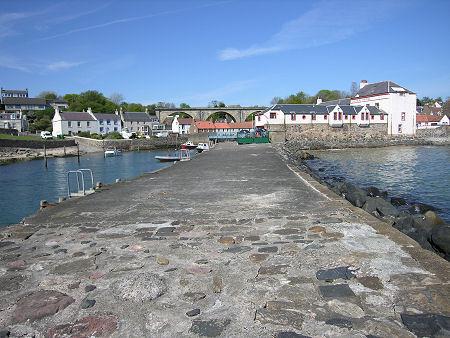
Lower Largo Harbour Pier, Fife, Scotland
Lower Largo Harbour & Pier, Fife, Scotland.

GODMOTHER, Miss MARY FOSTER, Bankhead, 12, Drum Park, Lower Largo, Fife, Scotland (1):

LETTER to Pte BERTIE HIBBETT, The Cenacle Red Cross Hospital, New Brighton, Cheshire.

                                                                                                        16/ 8/ 16.

My Dear Bertie,

At last the weather has broken & today is very stormy with heavy rain, but even as I write it is brightening as though to clear. 

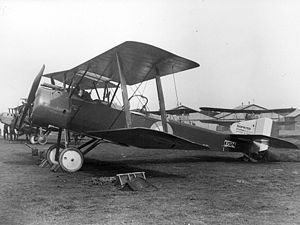
WW1 British Sopwith Strutter.
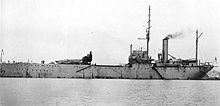
wiki 220px-Ark_Royal_(1914)
Ark Royal. First British sea-plane carrier. 
French aircraft carrier.<wiki.
French sea-plane carrier. WW1. 

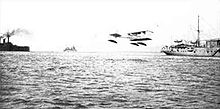
Just opposite our window, this morning, is the ship (2) which is the base for Hydro planes, of which we saw two yesterday (3).


I was very pleased to get your letter this morning, but is it not easier for you to write in pencil?  You will be thinking she takes a lot of pleasing – it is either “too good” or “too tired”, I know. But really it is “too good” this morning. I am sure it required a great effort & you know you need not exert yourself to do all your level best writing for me.

I can quite understand your feeling of depression, in fact, I have been expecting it when you settled down by yourself.  You see you have had a string of excitement up to now, & less time to brood.

I wonder if the time will come when you would like me to come up, & I wonder if it did whether you would say so. I wonder!  Would you? And do you know it would give me great pleasure to do so in that case? 

I can well understand that your thoughts go out to the ‘Boys of the Staffords’ & that you feel very much drawn to them in the grand work they are carrying on.  But my dear Boy you have nothing to regret – your part in this great task has been long & splendid. Have you ever thought how hard it would be to let you go again?

I do hope you will have a bit of good news from the Matron you wrote to – yes we will keep on praying hard for dear Sydney I always wake to wonder if we shall hear today.

Now, dear, you must not feel that you must answer when I write, but, as per usual, write just when you want to. If I write too often or too much you may tell me.  You will tell me all you learn about your arm, won’t you?  & “anything and everything”.

With best love from

Mary.

PS  Mrs Gorrie (4) sends her love to you & says she is thinking about you & how you will miss all your people.

************************

ELIZABETH HIBBETT WEBB

Almost as soon as he arrived at The Cenacle Hospital, Pte Bertie Hibbett began to write letters in search of his brother Sydney, missing since 1st July. He appears to have written to the Hospital Matrons he had met in France, at  Le Treport & Rouen.

My father was very fortunate to have a Godmother, like Mary Foster. From the beginning her kindly character shines  through in his Letters Home  – now we are able to see first-hand how wise and understanding a friend she was. She recognised his need to confide his sorrow to someone, other than his immediate family, and to tell her ‘anything & everything’. 

He also appears to have been experiencing what is now known as the ‘guilt of the survivor’ & the feeling he must get back to help his pals, ‘The Boys of the Staffords’.

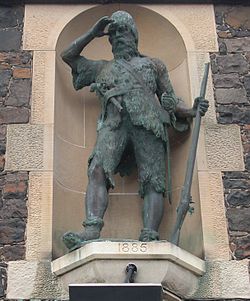
Statue: Alexander Selkirk, Lower Largo.

(1) Lower Largo, Fife: village in Largo Bay, Firth of Forth, Scotland. Birthplace of Alexander Selkirk, marooned 4 years on Juan Fernandez Island (South Pacific Ocean, 416 miles off coast of Chili). Inspiration for Daniel Defoe’s ‘Robinson Crusoe’.

(2) H.M.S. Ark Royal was the first British sea-plane carrier. Launched 5th Sept 1914. Supported troops in Gallipoli 1915 & Macedonia 1916. Unlikely to have been in Largo Bay in 1916?

(3) Hydro planes: British Sopwith 1½ Strutter (named after long & short cabane struts supporting wings). A squadron of biplanes was created in 1915-1916 to patrol Firth of Forth & North Sea against German Assault. First British aircraft to have synchronised machine gun to fire during battles without hitting the blades. In WW1 the French built twice as many Sopwith Strutters than the British. 

Aviation Fair Re-enactment Prague Czechoslovakia.WW1 Sopwith Strutter in action.
Aviation Fair Prague Czechoslovakia.WW1 Sopwith Strutter in action. Note Gunner. 2014.

(3Mrs Gorrie (old Scottish name) possibly No 12 Drum Park Guest House Landlady. Mary Foster often spent her annual holiday in Scotland.

NEXT POST: 17th Aug. 1916. Message from 1/5th Staffords Platoon Serjeant.

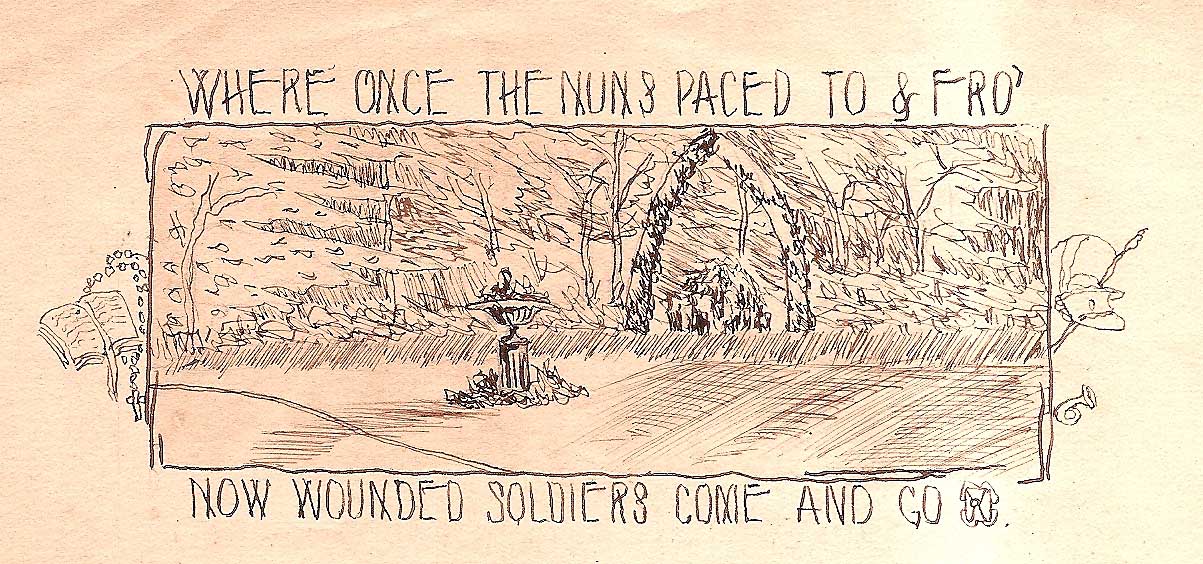
4th AUG. 1916: ‘WHERE ONCE THE NUNS PACED TO & FRO NOW WOUNDED SOLDIERS COME & GO’.

THE CENACLE RED CROSS HOSPITAL, NEW BRIGHTON: Pte BERTIE HIBBETT, MATRON, NURSES & WOUNDED PALS. 1916 -1917.

a.H.H.
The Cenacle Garden. Pen & Ink Drawing. A.H.Hibbet. Oct 1916.
Bertie
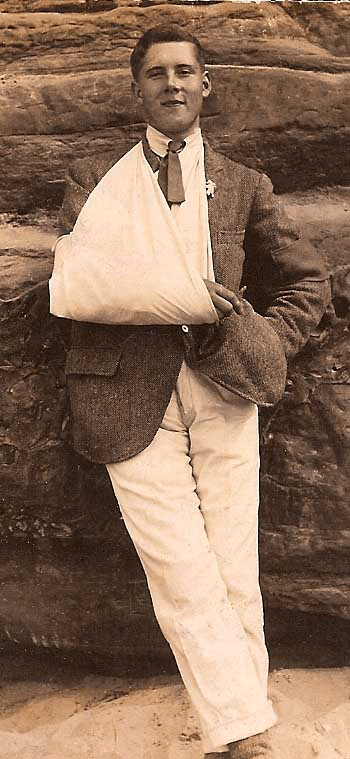
Pte Bertie Hibbett in mufti  & holding a cigarette on New Brighton beach July 1916.  He appears to have a plaster on his neck under his right ear covering a wound received when running out of the trenches.1.7.1916.

Pte BERTIE HIBBETT’S eldest brother, Harold, took most of these photographs during visits to The Cenacle between July 1916 -1917. As a Chemist he would have developed & also printed them.

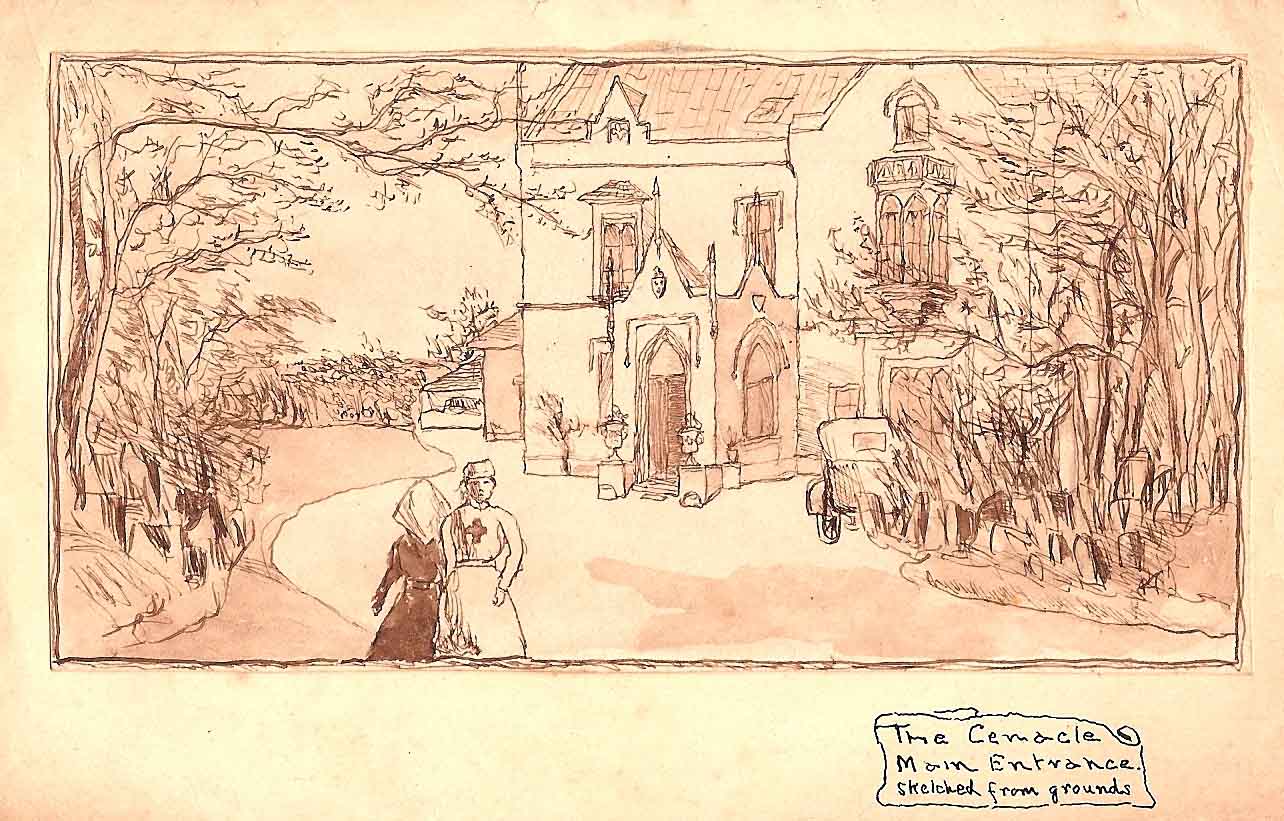
As well as drawing the house & grounds, Pte Bertie Hibbett tried his hand at a poem dedicated to The Cenacle.

Where once the Nuns paced to and fro’, Now Wounded Soldiers come and go, They liken the Cenacle to a herbal cure For the Matron and Nurses are so good and pure.

Oh! to sleep in a cosy bed On pillow soft to rest my head And have my sore wounds dressed by a kind nurse, Whose virtue is mercy and nothing worse.’ Oct 1916.

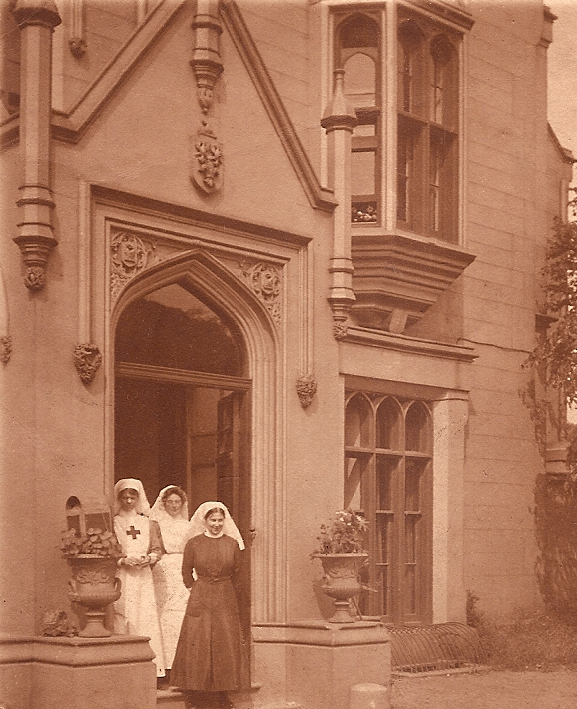
Matron & Nurses, Front door The Cenacle, Red Cross Hospital, New Brighton.
Matron & Nurses. Front door, The Cenacle, Red Cross Hospital, New Brighton.
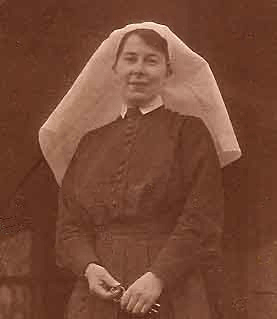
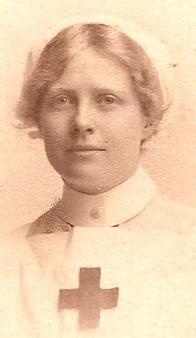
Matron
Matron Gertrude Bellow.

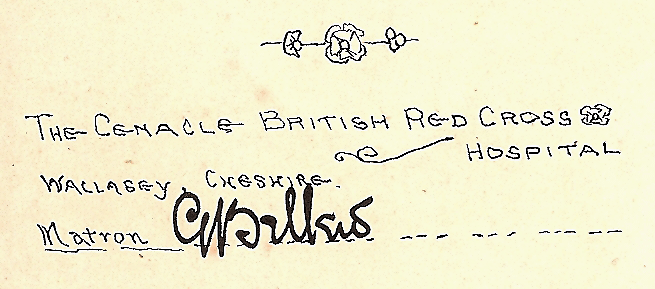
Matron's-Signature-The-Cenacle

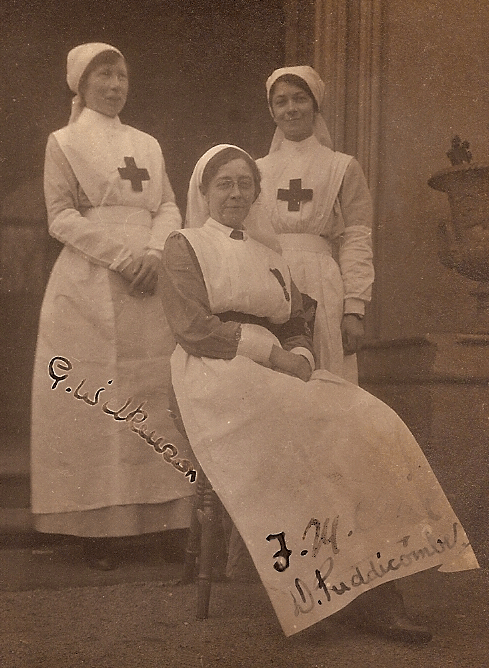
3 Nurses.
The Cenacle. Sister F.M.Clive with Red Cross Nurses G. Wilkinson & D. Puddicombe.
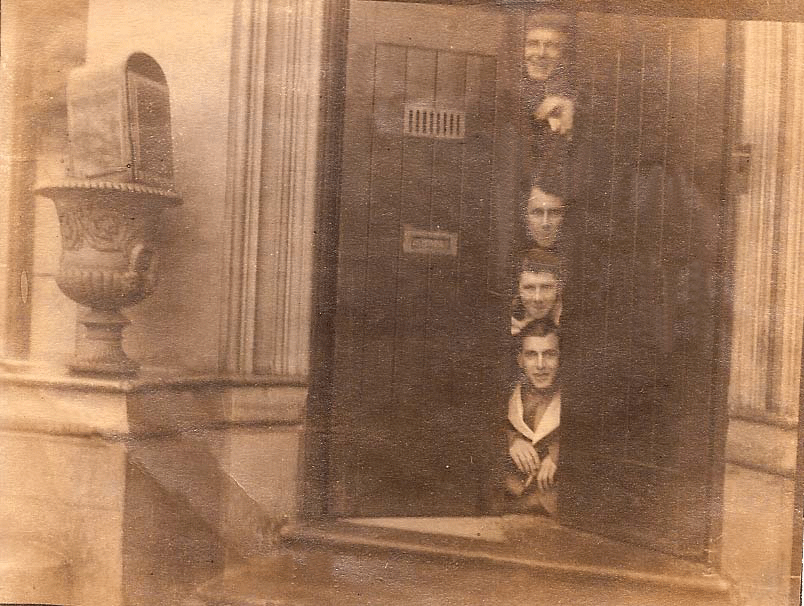
J. Turnbull, x x Bertie Hibbett, ?
Patient Heads at the The Cenacle Entrance: H. Turnbull, Beck, (Unknown but in photo 30th July post) , Bertie Hibbett & Bostock Byrd.
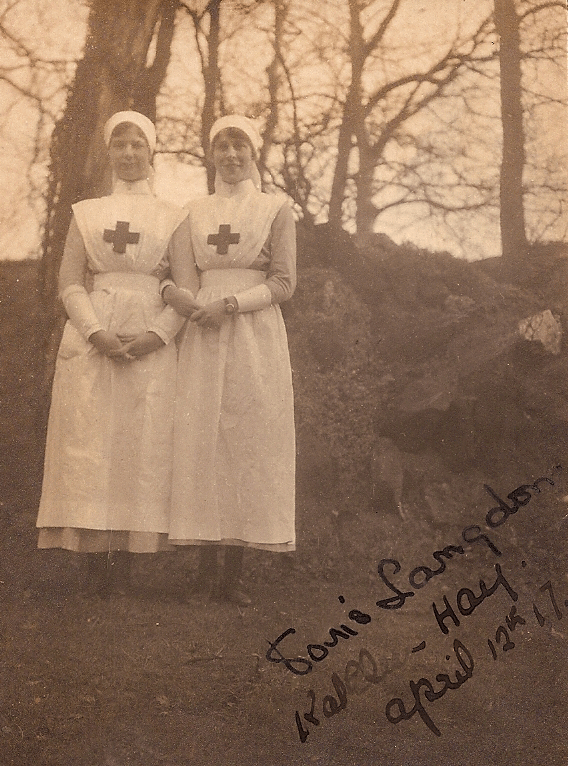
2 Nurses.
The Cenacle Red Cross Nurses: Sonia  Langdon & Kathleen Hay. April 12th 1917. 

*************************

ELIZABETH HIBBETT WEBB

It is clear from these photographs of smiling faces that the Matron Sisters & Red Cross Nurses at the Cenacle were indeed kindness itself.  I hope that readers researching their Mothers, Grandmothers & Aunts who were Red Cross Nurses in WW1 may find their relatives & their signatures here.

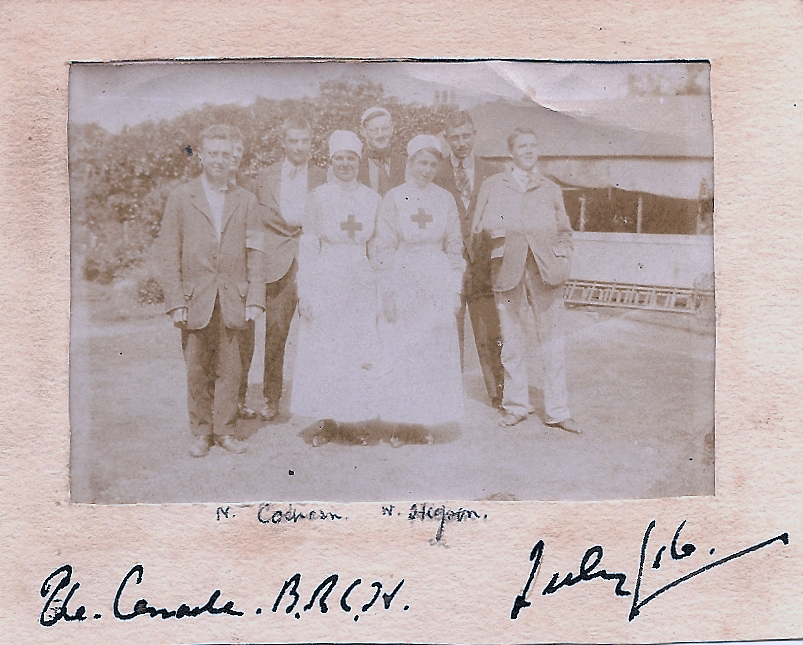
Patients appear to have been allowed to wear mufti when they had visitors. See photo below (most probably taken at the same time as the one of my father above with his arm in a sling). N.B. I think the names given refer to the Red Cross Nurses, N. Cockeram and N. Higson. A note under the photo states the man on the left was an Irishman – in which case he could be Pte Kelly, S. Irish Horse, who sang & played a Song entitled ‘Goo Goo Eyes!‘ at a Cenacle Concert. Oct. 1916. 

Cenacle-with-nurses-July-1916.

******************

NEXT POST: 16th AUG. 1916.

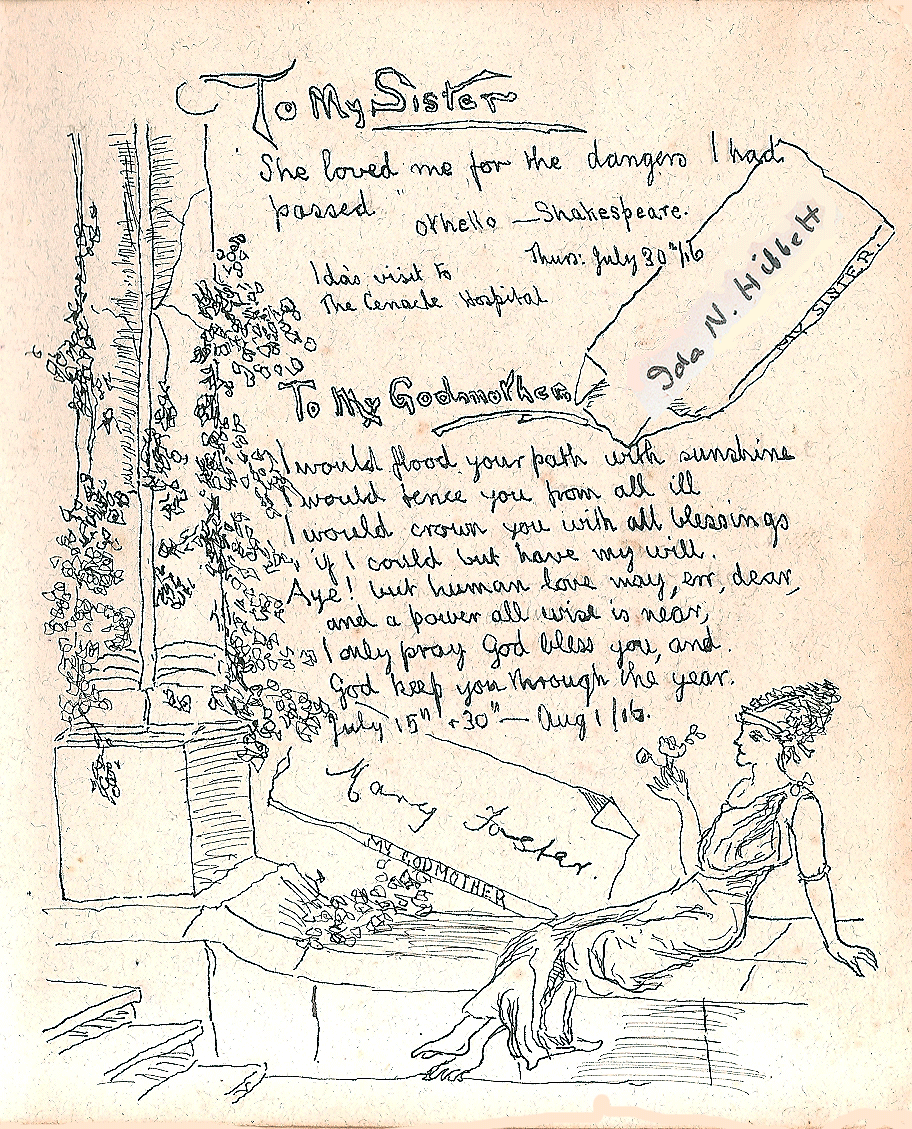
30th JULY: THE CENACLE HOSPITAL: ‘SHE LOVED ME FOR THE DANGERS I HAD PASSED.’

Bertie in UniformAUTOGRAPH ALBUM of Pte BERTIE HIBBETT, The Cenacle Red, Cross Hospital, New Brighton, Cheshire.

.Champion Ida Hibbett VAD Nurse.

VISIT of his sister Ida Neal Hibbett on 30th July 1916 & his Godmother Mary Foster on 15th & 30th -1st Aug. 1916.

Autograph Album To My Sister: ‘She Loved me for the dangers I had passed’. Othello. Shakespeare. Ida’s Visit to the Cenacle Hospital. Thurs. July 30th 1916.

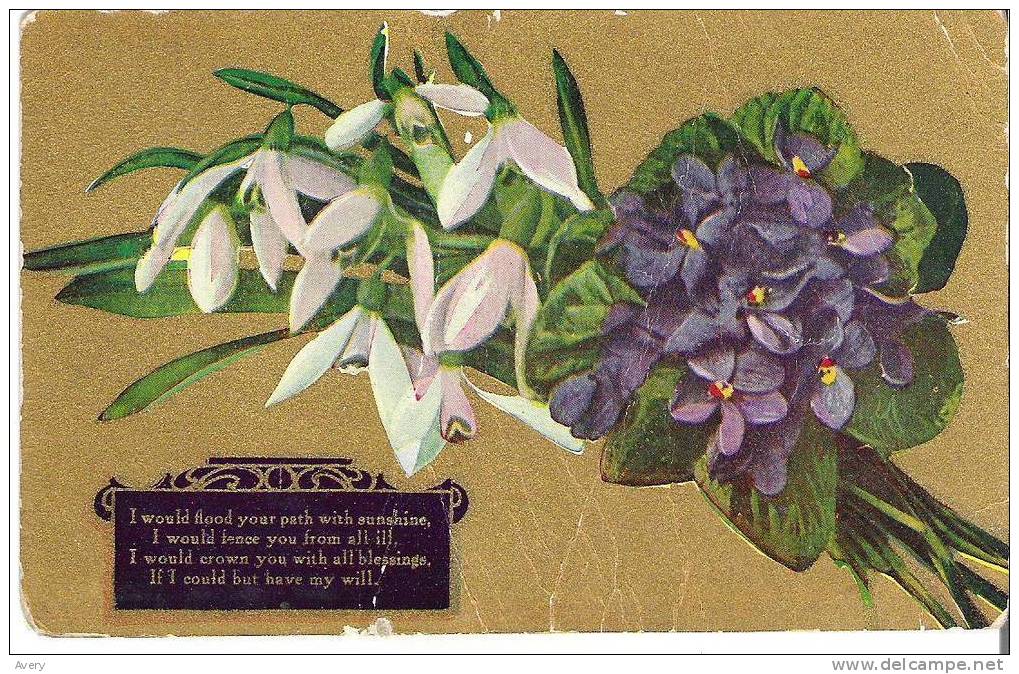
To My Godmother: ‘I would flood your path with sunshine, I would fence you from all ill, I would crown you with all blessings if I could but  have my will. Aye but human love may err, dear, and a power all-wise is near, I only pray God bless you  and God keep you through the year’ (1). July 15th & 30th – Aug.1st 1916.

1916 The Cenacle Front
The Cenacle Red Cross Hospital, New Brighton, Cheshire: Main Entrance sketched from grounds. Pte A.H.Hibbett. 1916 -1917.


The Cenacle, Red Cross Hospital, new Brigton. Birkenhead.
The Cenacle Red Cross Hospital, New Brighton. Cheshire. Pte Bertie Hibbett standing  3rd from right, with arm in sling.
Bertie
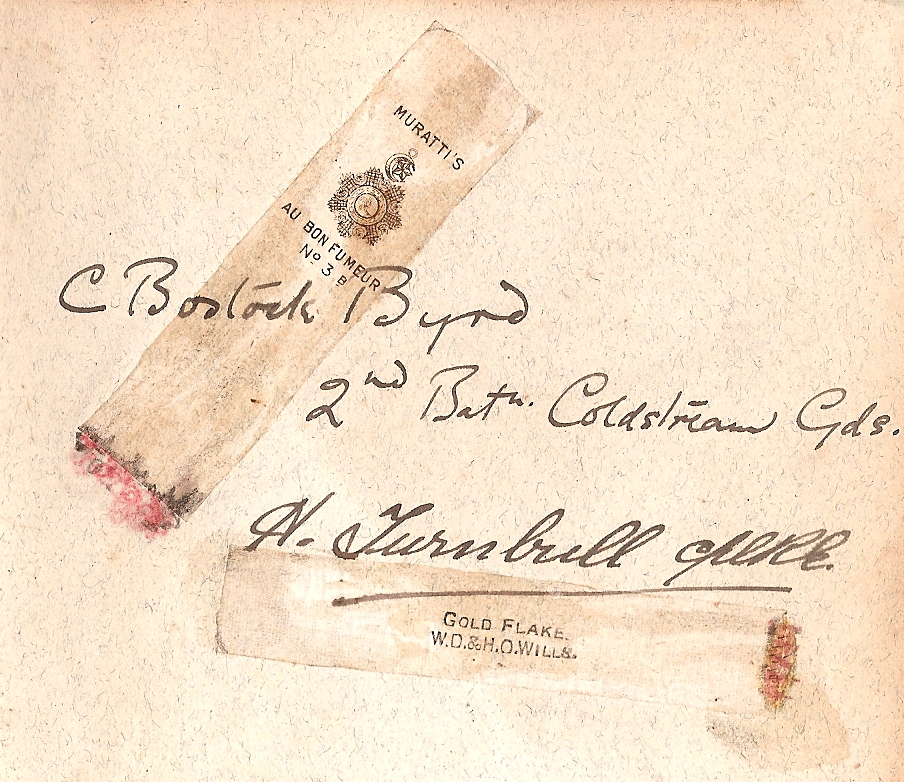
Pte Bertie Hibbett; Beck; C. Bostock Byrd; Cpl. H.Turnbull;   ?
Coldstream Guards:
Coldstream Guards: C.Bostock Byrd, 2nd Bn Coldstream Guards.( Muratti’s Au Bon Fumeur); H. Turnbull Cpl RE. (Gold Flake. W.D.& H.O.Wills).
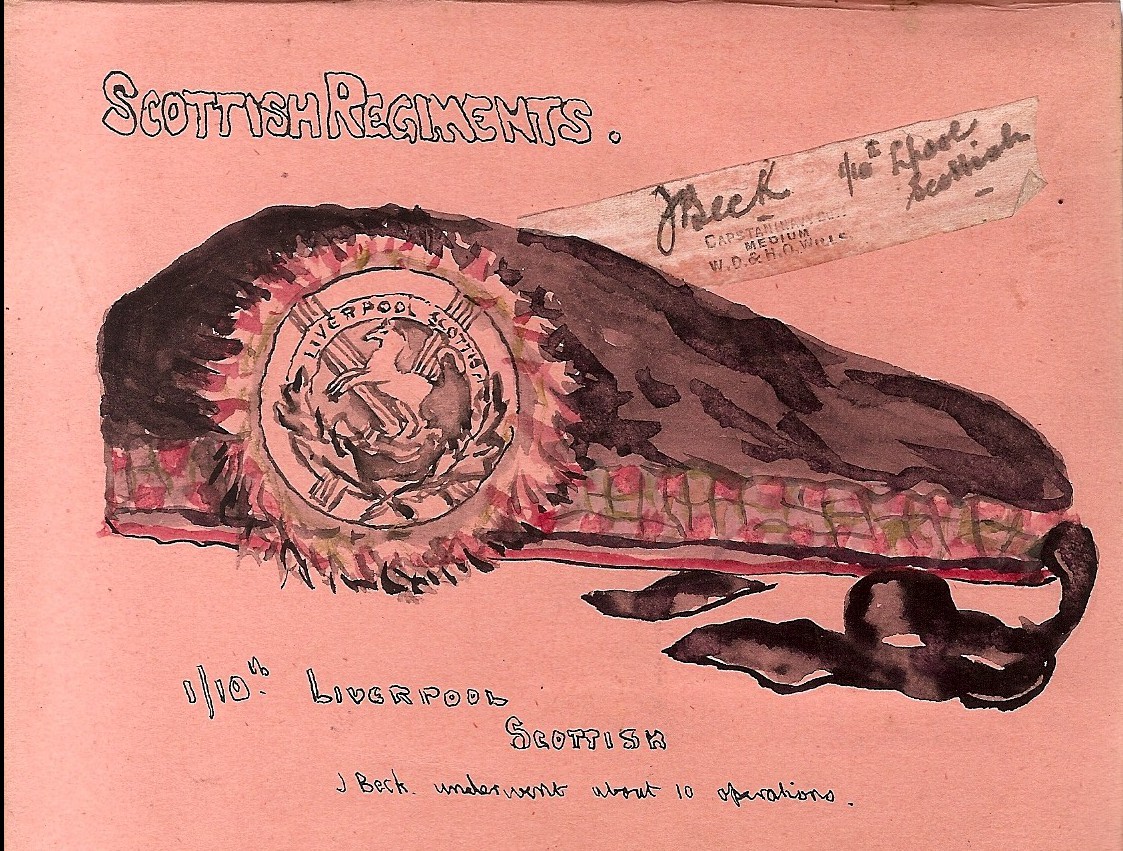
SCOTTISH REGIMENTS.
SCOTTISH REGIMENTS. J. Beck 1/10th Liverpool Scottish.  (Capstan Medium W.D. & H.O.Wills). ‘J. Beck underwent about 10 operations’. A.H. Hibbett Autograph Album. 1916.

******************

The Revd. Arthur H. Hibbett.

My Memories: A friend gave me an autograph book in which I collected autos of the patients, written on cigarettes, which I cut in half and pasted on the pages.  I spent my time doing drawings and sketches with my left hand. The Revd Arthur H. Hibbett 1967.

******************

ELIZABETH HIBBETT WEBB

The Cenacle belonged to a Roman Catholic Presbytery and was the Home of Nuns before it was lent to the Red Cross as a Hospital for wounded soldiers. My father kept up with several of his fellow patients & especially the Matron for some years after the War.

(1) Poem:I would flood your path with sunshine, I would fence you from all ill; I would crown you with all blessings if I could but have my will. Aye! but human love may err, dear, & a power all wise is near. I will pray God bless you, and God keep you through the year.’ (Unable to trace poet but poem known before 1909).

www.delcamp.net
‘I would flood your path with sunshine’. Post Card. <http://www.delcamp.net&gt;

NEXT POST: 4th Aug. 1916. The Cenacle Red  Cross Hospital Nurses & Patients.

29th July 1916: OPEN AIR SERVICES: ‘EVERYONE HAS BEEN VERY GOOD IN TURNING OUT FOR US’.

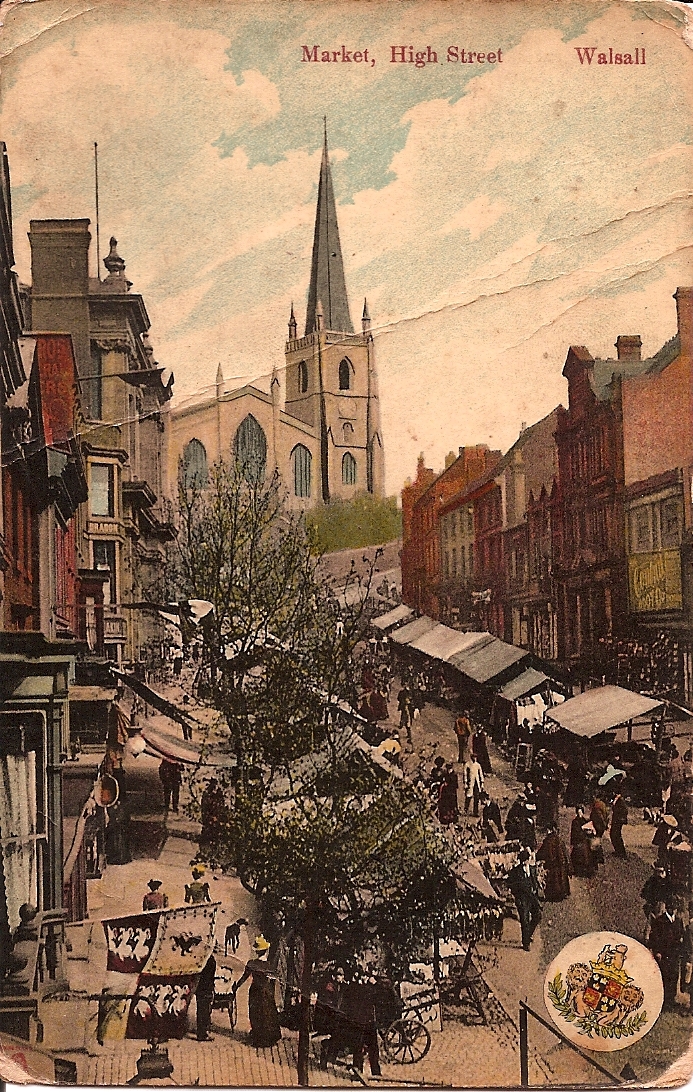
Market High Street, Walsall
The Parish Church of St Matthew & Market High Street, Walsall. PC1914.

The Revd E. MORE DARLING, former Vicar of St Matthew’s Parish Church, Walsall: LETTER to Pte BERTIE HIBBETT, The Cenacle, Red Cross Hospital, New Brighton, Cheshire.

Streetly. Saturday.

My Dear Old  Chap,

Mr Cozens (1)* was in last evening and from him I heard, what you had not told me, that you were wounded in the hand. I know how painful and awkward that can be – Major Caddick* had a somewhat similar wound – but I hope that by now you are beginning to go on in the right way.  It’s a slow job old Chap so don’t be dis-heartened – not that I think you will, but it’s not easy not to be. 

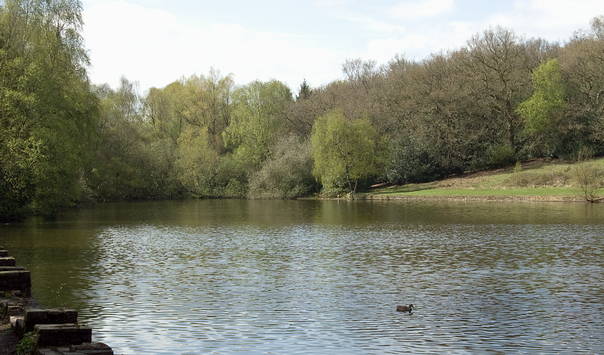
Sutton Park: Keeper's Pool.
Sutton Park: Keeper’s Pool.

Let me know as soon as you are likely to be over as I should like to have you here for a long day to show you all the beauties of the Park (2). 

You will be very interested in my baby, who is getting on splendidly. The Allied Flag you sent him is being preserved for him until he is bigger. His one idea now is to tear things and bang them about.

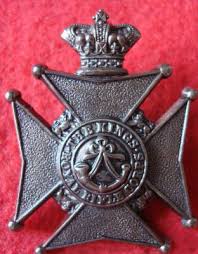
KRRC badgeimgres
Kings Royal Rifles..

Did you know Joe Dyall* was wounded? He’s in a hospital in Manchester – I’ve just written to him.  He was in the K.R.R.’s you know (3). The son of one of my very best Churchmen is an officer in the same regimenthe’s just been severely wounded, how severely we don’t know yet, but I’m afraid it’s rather bad.

Did I tell you we’ve been having open-air services here?  We’ve had five and they’ve been very helpful. Everyone has been awfully good in turning out with us. Now hurry up and get better and remember I’ve booked you for a full day here. I’d like it to be a Sunday, but mustn’t ask your Mother and Father to spare you for that as Sunday is the day to be at Home.

My wife wishes to be remembered to you and the baby sends a kiss.

Always your friend,

E. More Darling.

************************

ELIZABETH HIBBETT WEBB

The Revd E. More Darling remained a friend to Bertie Hibbett for the rest of his life. He had left Walsall in March 1916 for a living 5 miles away at Streetly (named after the Roman RoadIcknield Street’, traces of which may be seen in Sutton Park close by). It was to be quite some time before my father was allowed to go Home.

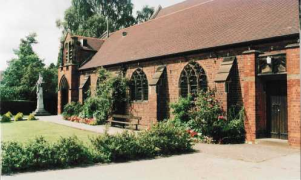
All Saints Streetly Staffordshire.
All Saints Streetly, Staffordshire.

Open Air Church Services became popular during WW1; Christians of all denominations were able to join together on an equal footing.

(1) Mr Cozens*: Henry Cozens, leading churchman at St Paul’s Walsall, father of Capt.Tim Cozens Killed in Action Battle of Loos 1915?  Hibbett Letters: 13th Sept, 1915; 15th Oct .1915; 24th Oct. 1915.

(2) Sutton Park: 7th largest Urban Park in Europe, 6 miles north of Birmingham – now a National Nature Reserve & Site of Special Scientific Interest (SSSI). Landscape of open heathland, woodland, wetlands, marshes & lakes. Mentioned several times in Hibbett Letters: e.g.10th Nov. 1915; 16th July 1915; 21st May 1916. WW1 Convalescent Camps erected in the Park. See <http://www.scnhsc.org.lakes&gt;

(3) K.R.R.: Kings Royal Rifles Corps formed 1755-56 in North America from 62nd & 60th American Regt. Sir Edward James Montague Stuart- Wortley, 1857 -1934, belonged K.R.R.C before Commanding 46th Midland Division in WW1 (Battle of Loos & Battle of Somme).

NEXT POST: 30th July. Autograph Album: ‘She loved me for the dangers I had passed’.

July 1916: PTE BERTIE’S 21ST BIRTHDAY: ‘ABLE TO EAT? YES. ABLE TO WALK? YES & DANCE FOR JOY TOO!’

MARIE NEAL HIBBETT: 53 in 1914.
MARIE NEAL HIBBETT:
54 on 13th July, 1916.

Bertie in UniformPte BERTIE HIBBETT, at the Cenacle, Red Cross Hospital, in July 1916, received an Autograph Album with the message:

‘Wishing you very many Happy Returns of your Birthday from your Chums’.  Mother. (My father has added ‘Enoch, Vernon Evans‘) (1) .

Autograph-Album-page-1
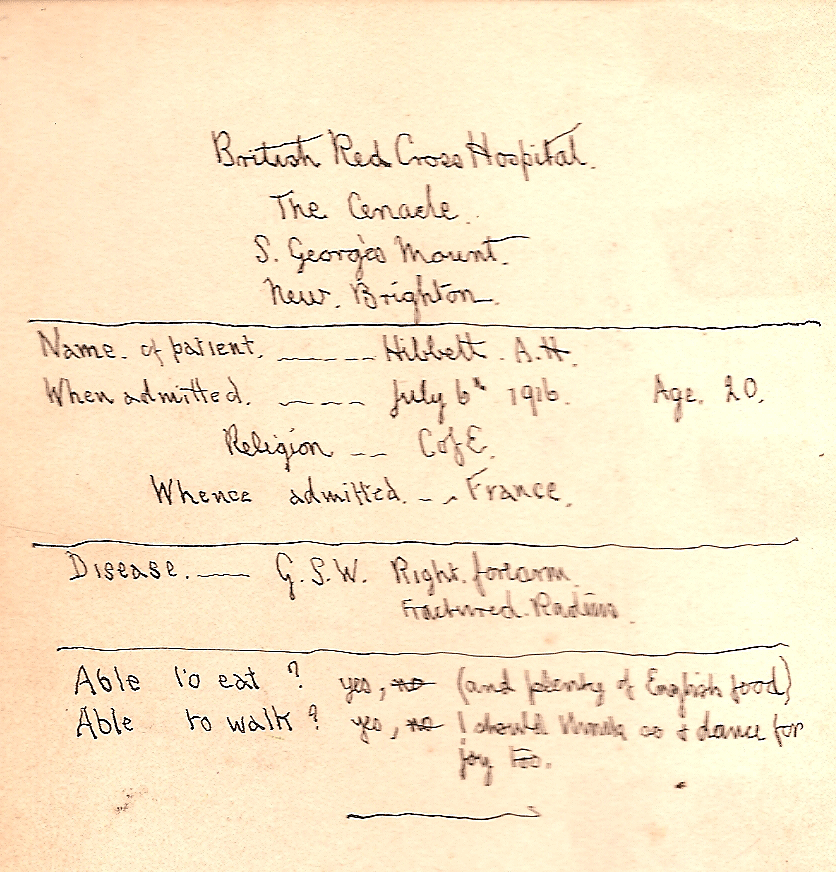
Disease – G.S.W. (Gun Shot Wound) Right forearm. Fractured Radius.   Able to eat? Yes, (and plenty of English food). Able to Walk? Yes, I should think so & dance for joy too.

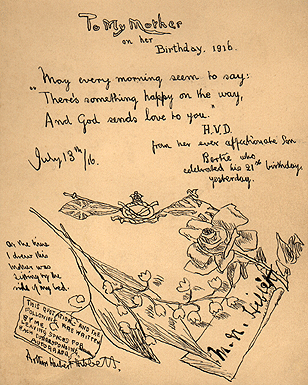
On 13th July his Mother visited Bertie at the Cenacle and with his left hand he drew  her a special page with the Stafford Knot, Union Jacks, a Lily of the Valley and a Rose, her favourite flowers.

‘At the time I drew this Mother was sitting by the side of my bed’.

To Mother

To my Mother on her Birthday. July 13th 1916: ‘May every morning seem to say: “There’s something happy on the way, And God sends love to you” H.V.D. from her ever affectionate Son, Bertie, who celebrated his 21st Birthday yesterday.’  The box left reads: ‘This Quotation and the Following are written by Me leaving Spaces for each Corresponding Autograph. Arthur Hubert Hibbett. 

*****************************

ELIZABETH HIBBETT WEBB

Pte Bertie Hibbett’s best pal Vernon Evans, still serving in the Army, had obviously asked Bertie’s Mother to  take him a present. It was an inspired present for three weeks after he was wounded my father had taught his left hand to write & draw well again. The Album was a present that he took pleasure in for the rest of his life.

During the time he was in Hospital my father began to collect signatures of his fellow patients, written on their carefully pressed & pasted cigarette papers. 

Cigarettes papers & signatures.
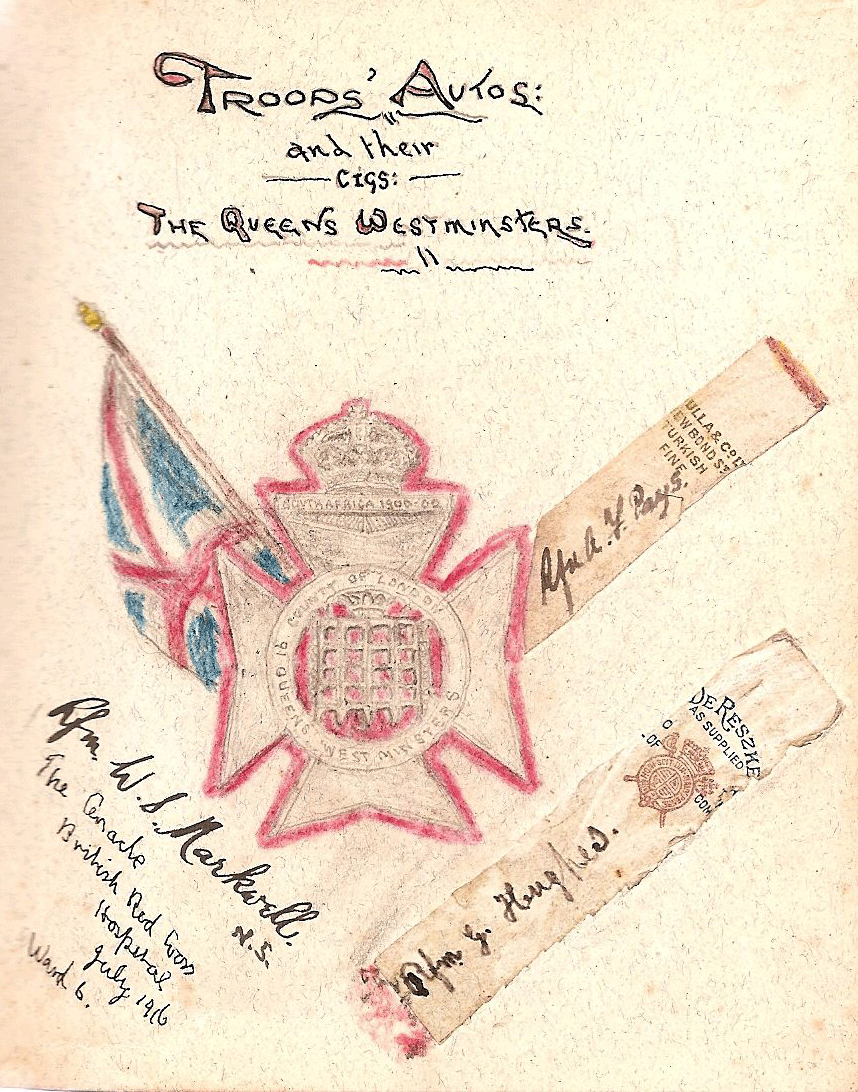
Troops Autos and their Cigs. The Queen’s Westminsters. Wounded soldiers’ Cigarette Papers & Signatures. The Cenacle, Red Cross Hospital, New Brighton, Cheshire. July 1916.

The signatures above belong to soldiers of the Queen’s Westminster Regiment, Ward 6, The Cenacle Red Cross Hospital, July 1916. The Badge records the Regiment’s service in South Africa,1906 -1909. County of London. Queen’s Westminsters. Clockwise from top right: Rifleman A.F. Bays (Wills & Co Ltd New Bond Street. Turkish Fine); Rifleman G. Hughes (De Reszke as supplied) & Rifleman W.S. Markwell N.S.

*****************

I can imagine that first visit of Pte Bertie’s parents and the stories he told them of his journey home. These memories were still strong in 1967, no doubt re-enforced by frequent reference over the years to his 21st Birthday Autograph Album.

Revd. Arthur H. Hibbett 1965My Memories of the First World War. 1967. 

As ‘sorrowful yet alway rejoicing!’(2)how we rejoiced to see Southamptonand from the railway carriages, what a sight it was to see all the men, women and children – all waving Union Jacks from their back gardens for miles along the line to Birmingham.

When we neared our home town of Walsall we Staffordshire boys thought we would be detrained at Birmingham station, but no, we remained in locked carriages and a rope, stretching all along the platform, kept people awayNevertheless people threw packets of fags and boxes of chocolates, and other articles of food, towards those soldiers who could get to the windows.

We eventually arrived at Birkenhead, where lots of private cars were waiting to take us to the different hospitals I was taken in a car with another soldier who was also wounded in his right wrist. I heard later that the poor man died. And so I was left. 

It made me think, and ask why my brother was left on the field of Battle, reported wounded and missing, and why my companion in the car, with similar wound as me, had died while I lived on. 

Cenacle
Pte Bertie Hibbett centre. The Cenacle, Red Cross Hospital. New Brighton Cheshire. 1916-1917.

I spent seven months in The Cenacle Red Cross Hospital in New Brighton.  During that time I asked for my Latin and Greek Grammar books, but found it difficult to study (3).

A friend gave me an autograph book in which I collected autos of the patients, written on cigarettes, which I cut in half and pasted on the pages. I spent my time doing drawings and sketches with my left hand.

ELIZABETH HIBBETT WEBB

(1) Enoch Evans was Vernon Evans’ father, not his brother as it appears here.

(2‘As sorrowful yet alway rejoicing’. St Paul. 2 Corinthians, 6.10.  AD 55 approx. [K.J.V. King James 1st Version, 3rd English translation of Bible, 1604-1611. NB. No major revision of K.J.V. until the RSV (Revised Standard Version)  & a whole range of English translations mid 20th Cent. following development of rigorous academic methods of historical biblical criticism; something I was able to share with my Dad in 1960s as he tackled the introduction of new liturgies in the Anglican Church & I studied for my degree.

(3) Latin & Greek were pre-requisites for training in the Anglican Ministry in my father’s day. The philosophy behind such study is basically the same as it should be today – that anyone seeking to understand and teach biblical literature (as it was first intended by the Gospel writers) must have a working knowledge of 1st cent colloquial (‘koine’) Greek as found in the New Testament, before they offer an interpretation and attempt to apply it as relevant for the present. A basic qualification in Hebrew is also useful – in understanding the essentially poetic language of the Old Testament/ Hebrew Bible – and as an antidote to misleading literalism. Sadly, too often, one hears interpretations that give a message almost the opposite of a text’s intention in its historical context! 

NEXT POST: 29th July 1916.