All posts by Elizabeth Hibbett Webb

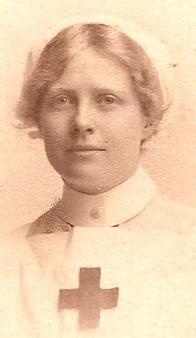
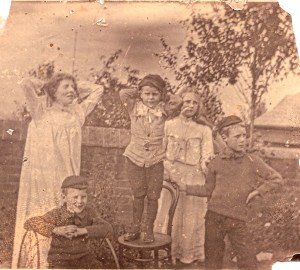
My aim is to publish, in date order, the letters my father, Private Bertie Hibbett, wrote home to Walsall, almost twice a week, from 1914 – 1918. His self-styled ‘humble scribblings’ give a vivid picture of what it was like to be a Private in Kitchener’s Army but, with their original drawings, sketches and photographs, they provide an important collection of primary source material for social historians in this centenary year of the outbreak of the Great War. As a child I was more aware of the 1st World War than of the 2nd, through which I grew up. My father was Vicar of St Vedast’s Church, Tathwell, Lincolnshire and I was never allowed to forget that my birthday was also St Vedast’s Day, for this was an ever present reminder to him of his dawn sentry duty on Easter Day 1915, at Neuville St. Vaast, Messines. * Like my grandfather, Arthur Hibbett, Chief Inspector of Schools for the Borough of Walsall, my career has been in education; mainly in higher and further education, where I taught courses in historical and literary interpretation & methodology. I have a BA Hons.degree in Theology and History from the University of Nottingham and a Master’s degree in Hermeneutics from the University of Bristol. My first teaching post was at Luton High School, then I became Lecturer & Senior Lecturer in Theology and Religious Studies at the College of St Matthias, Fishponds, teaching the University of Bristol, B.Ed. degree. After my marriage, in 1971, to David Kester Webb (painter, photographer and teacher), I became the first Open University Tutor Counsellor and Associate Lecturer in North Devon, from 1974 until 2000. During that time I also taught Religious Studies ‘A’ level at North Devon College. Kester and I published our book, The Hidden Edge of Exmoor,in 2011 (www.thematic-trails.org). This is the story of our life-time’s climbing exploration of the Exmoor Coast at Sea-level; literally hands on geology. We have two offspring: Rebekah (Consultant in International Development: Gender/HIV/Aids) and Martin Vedast, (Project Manager in Ceramics for Disabled Adults). * NB The name Vedast or Vaast means Foster in English. St Vedast was a 4th C. saint, patron of numerous churches in N. Europe, chiefly of Arras Cathedral. Apart from St Vedast Tathwell, the only other church in the Uk with this patronage is St Vedast, Foster Lane London.

21ST NOV. 1916: GOMMECOURT: ‘HEROIC WORK’ ‘THINGS OF PLAIN IMPOSSIBILITY’.

BASIL HIBBETT
BASIL HIBBETT.

BASIL HIBBETT, 95 Foden Rd: LETTER to Pte  BERTIE HIBBETT, The Cenacle Red Cross Hospital, Wallasey, New Brighton.

Tuesday 10. 0 am.  (Ed. 21st Nov. 1916) (1).

Dear Bertie,

I was reading the paper a few minutes ago about the new attack north of the Ancre (2) – the part of the line not captured on July 1st.  There are a few lines I would like to quote to your benefit:-

Though the attack north of the Ancre on July 1st (Gommecourt, Serre & Beaumont-Hamel) did not result in permanent gains such as those which have crowned our arms south of that river, the story of what was done there in the first stages of the offensive is such that, when it is fully told, Great Britain may perhaps be even prouder of the deeds of the regiments which fought on this section of the front and which achieved there some things of plain impossibility than of the successes further south”

“It may be doubted if the world ever saw an hour of more heroic work than our men did there” ‘Times’

That’s you & Sydney. Isn’t it fine?    Love from 

Dodger.

**************************

ELIZABETH HIBBETT WEBB

The Battle of the Somme ground to a halt with a final British attack, the Battle of Ancre, 13th -18th, Nov. 1916 and the onset of winter. Since 1st July, 20,000 British lives had been lost  & very little ground had been gained.  Pte Bertie Hibbett (suffering from grief, shell shock & a life changing injury) needed to know, along with the whole nation, that those who fought & died in the first stages of the Offensive had not toiled or died in vain. This Times’ report, sent to his brother by a thoughtful Basil, met a real need: the men were heroes & had achieved ‘things of plain impossibility’. 

Sir Stuart Wortley.
Sir Stuart Wortley. 1857-1934.

The Hibbett Family must have known by now that 46th Midland Division’s diversionary attack on Gommecourt, on 1st July 1916, was considered a complete failure. Blamed on its Commanding Officer, Sir Stuart Wortley (controversially dismissed by Earl Haig, 4th July), the failure left a shadow on the reputation of the men that must have been very hard to bear. 
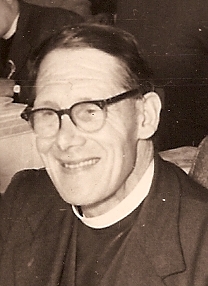
Revd. Arthur H. Hibbett 1965
The Revd. Arthur H. Hibbett. Butlin’s Skegness. 1960s.

In My Memories. 1967, my father recalls his personal experience of the chaotic situation in the Foncquevillers trenches in that first half hour – and the dismay of his Commanding Officer at the sight of so many casualties – but he was not in the habit of apportioning blame. He had great respect for his Officers, especially those he had known from QMS Cadet days & throughout his time at the Front.  I remember how difficult he found the musical ‘O what a Lovely War!’ released 10th April, 1969.  ‘It wasn’t like that!’ he said.

My father would have appreciated the understanding of Alan MacDonald’s two definitive books on Gommecourt: Pro Patria Moriand ‘A Lack of Offensive Spirit’.

Eddie. Caricature by Spy in Vanity Fair 1899.
Edward Stuart Wortley. 1857 -1934. ‘Eddie’. Caricature by Spy in Vanity Fair 1899.

Quotation:-<http://www.en.wikipedia.org/wiki/Edward_ Montague-Stuart-Wortley>  ‘ VII Corps commander, Lieutenant-General Thomas D’Oyly Snow, stated in official correspondence:

“the 46th Division … showed a lack of offensive spirit. I can only attribute this to the fact that its commander, Major-General the Hon. E.J. Montagu Stuart-Wortley, is not of an age, neither has he the constitution, to allow him to be as much among his men in the front lines as is necessary to imbue all ranks with confidence and spirit.”

General Snow ordered a Court of Inquiry on 4 July 1916 into the actions of the 46th Division during the attack, but before it delivered its findings General Haig as Commander-in-Chief ordered Montagu-Stuart-Wortley to leave the field and return to England.

Given that Montagu Stuart-Wortley’s orders prior to the attack had been “to occupy the ground that is won by the artillery” his dismissal remains a subject of controversy. According to Alan MacDonald, “the Division and its General were made scapegoats for the failure of a fatally flawed concept dreamt up by higher authority – the diversionary attack at Gommecourt“.

See also Hibbett Letters: 1st July 1916; 4th June 1916; 16th July 1915.

*********************

(1) The Letter’s Date: the first Tuesday after the Battle of Ancre 13th -18th Nov. was 21st Nov. 1916.  Basil was most likely reading that day’s Times. 

(2) The Battle of Ancre: the last major British attack of the Battle of the Somme, 13th -18th Nov. 1916. Operations on the Somme came to a halt because of the winter weather, ‘rain, snow, fog, mud, waterlogged trenches & shell holes’. 18th Nov.1916 is commemorated as the end of the Somme Offensive but research by Historian Peter Barton indicates the actual date was the Spring of 1917 when the Germans withdrew to the Hindenburg Line, a German defensive line from Arras to Laffeux, near Soisons on the Aisne. See BBC 2 broadcast/ August 2016: The Somme 1916. From Both Sides the Wire.

NEXT POST: 25th NOV. 1916: ‘A Special & Careful Examination of Your Son’s Injury’.
20TH NOV.1916: THE SOMME. A DREAM & THE NATIONAL MISSION OF REPENTANCE & HOPE.

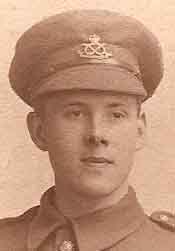
Bertie in UniformPte BERTIE HIBBETT, The Cenacle, Wallesley, New Brighton, Cheshire: LETTER to ARTHUR & MARIE NEAL HIBBETT, 95 Foden Rd Walsall.

Monday Morning. 20.11 16.

National Mission (1):God is decreeing to begin some new and great period in His Church, even to the reforming of the Reformation itself; what does he then but reveal Himself to His servants, and as His manner is, first to His Englishmen.’ Milton’s Areopagitica (2).

My Dear Mother, Father, & hmm . . . Isn’t it awkward to begin for you are all dear to me.

Cuirassier with sword.

I dreamt such a dream last night. I dreamt I saw a host of cavalry, the men wearing glittering gold helmets like the French Cuirassiers (3). 

I thought they were Germans at first, then French, as I saw them in the distance on the road, then as I turned in the opposite direction who should I see but Sydney mounted on a charger with a banner in his hand & what appeared to be a helmet covered with leaves (4), he came galloping along & gave me the impression he was a messenger to tell us the enemy was near.  The dream went on, he & I were on the top of an old barn, then we were with father.

I had not dreamt of Sydney much since you left New Brighton & I wished I would & so I did last night. I should so much like him to keep me company today & give me advice on matters.

Yesterday I spent a very quiet Sunday, although it rained.  I read Milton’s works in the afternoon & Mother’s book The Prince of the House of David (5), in the evening.  I have got to the letters where Adina loses all hope in Our Lord & where she resolves not to believe in the righteousness of men.  How she sorrows to think that so good a ‘Man’ was ‘dead’ & she was still alive. I think of Sydney now & compare: it is comforting to know he is not really dead, but if we allow ourselves to disregard Christianity he will then appear dead to us, just like Adina, who was either ignorant or doubtful as to Our Lord’s coming Resurrection.

Christmas is drawing very near now; my arm is growing gradually stronger, but still has not yet healed upkeeps breaking out in little holesall I have is a hot fomentation & some lotion to stop it from going septicSo Doctor Utting* could easily do that (6): now what I am aiming at iscould Dad write to Schlater* (7), 3 Earlston Rd. Liscard N.B. for just 3 or 4 days at Home or even 2 if I should happen to be here by Christmas. The other day he said :- ‘I know you would like to be here for Christmas (or something to that effect)’.  Perhaps it is rather early as yet.  We will consider the matter eh!’

I had a very nice letter from Okoo* (Basil) yesterday.  He’s a decent sport to do me some photos.  Nurse Wilcox* wishes to have one. 

Not being able to think of more to say excepting we too are having dull & cold weather. Oh! just had a letter from Mary* ( Godmother Foster), they had snow in Nott:(ingham).

Best love,  Your ever affec.  Bertie.

*************************

ELIZABETH HIBBETT WEBB

‘The War will soon be over now’ wrote Sgt Sydney Hibbett in his last letter home  before the ‘Big Push’ of 1st July 1916. Both Pte Bertie Hibbett and his brother had volunteered in the hope to fight and save their country & the world. With the Battle of the Somme failing to make any real headway from the very first day, after so much expectation of success and with such horrendous loss of life, there was a growing awareness in a grieving nation that the War could not be over soon.

This letter shows how close Pte Bertie Hibbett was to his brother, Sydney (only 13 months between them) and how he endeavoured to make sense of what had happened to them both.  Characteristically he takes comfort from his vivid dream of his brother as a knight in shining armour – and creates links between John Milton’s 17th Century call for ‘a reforming of the Reformation’ and the Church’s present call for National Repentance & Hope. 

(1) The National Mission of Repentance & Hope launched by the Archbishop of Canterbury, Randall Davidson & the Archbishop of York, Cosmo Lang. Oct. 1916. See A Monument of Fame: The Lambeth Palace Library blog: 13th March, 2016. 

We are to repent not because we believe we are guilty of provoking this war but because we, together with other nations that profess to be Christian, have failed to learn how to live together as a Christian family, how to set forth Christ to the peoples who do not know Him. Because it is clear that the Spirit of love does not rule our relations with one another at home, anymore than it rules the relations between nations’.

‘We look forward  to a new England & a new world’. . . ‘The nation was invited ‘to reflect their attitudes, weaknesses & passions & repent in hope of a better world’.  . . ‘ . The Bishop of London, Arthur Winnington Ingram said: ‘The Mission is to be like the coming of Spring  . . . that under the breath of the Spirit “a desert may rejoice & blossom as the rose”. Church Times, March, 1916. [See also Hibbett Letter 20th July 1916, from the Vicar of Walsall, the Revd J.J.Key] .

1st page of Areopagitica 16
Milton’s Areopagitica. 1644.

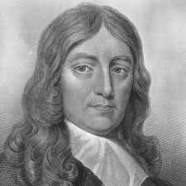
(2) John Milton, 1608 -1674. English poet, man of letters, civil servant to Oliver Cromwell

Milton
John Milton

Milton’s Areopagitica: For the Liberty of Unlicensed Printing‘ was a passionate philosophical defence of the right of freedom of speech / an appeal to Parliament to rescind the Licensing Act of 16th June,1643, on state control of printing, speech & thought. See <http://www.stlawrenceinstitute.org&gt;

Cuirassier with sword.
Cuirassier with helmet plume & sword.<http://www.pinterest.com&gt;

(3) French Cuirassiers: Cavalry Armour Bearers similar to Medieval Men at Arms, last fielded in WW1 (‘from ‘cuirass’ breast-plate armour).

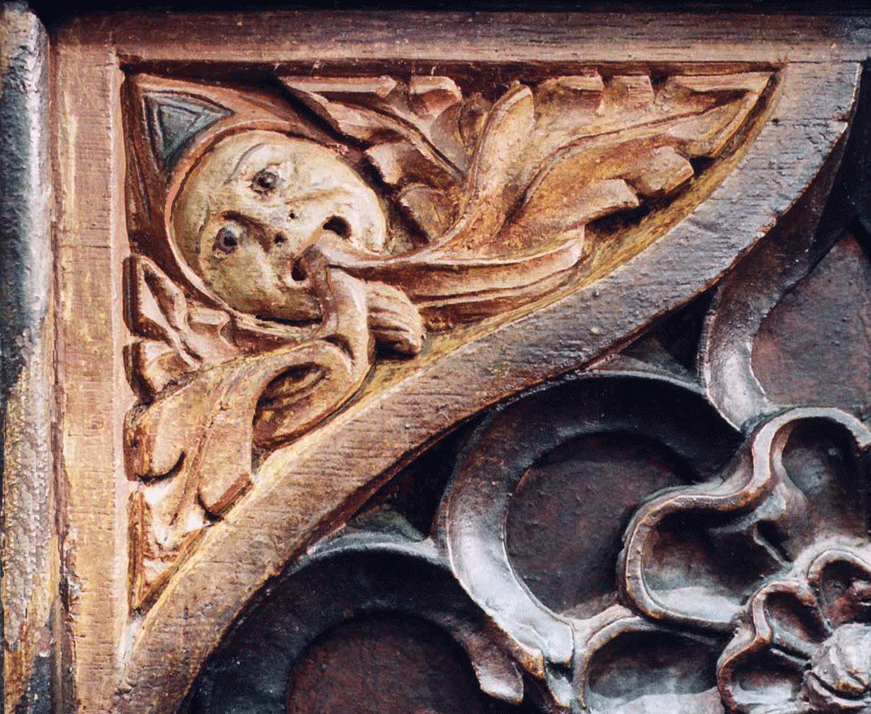
Green Man Roodscreen Combe Martin 1500-1550
Green Man: Roodscreen, St Peter Ad Vincula, Combe Martin.1500-1550.

(4) Sydney’s Helmet covered with leaves (laurel wreath of victory) reflects symbolism of Green Man with leaves pouring from his mouth/archetypal image of Renewal & New Life. cf Sir Gawain & the Green Knight/ 14th Cent. Arthurian Poem.

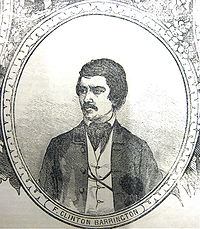
Revd Joseph Holt Ingraham 1809 -1860.
The Revd Joseph Holt Ingraham. 1809 -1860.

(5) ‘The Prince of the House of David, or Three Years in the Holy City’. The Revd Professor Joseph Holt Ingraham (F. Clinton Barrington)1809 -1860. 
Title reads: ‘being a Series of Letters of Adina, a Jewess of Alexandria, sojourning in Jerusalem in the days of Herod, addressed to her father, a wealthy Jew of Egypt (Manasseh Benjamin) and relating, as if by an eye-witness, all the scenes & wonderful incidents of the Life of Jesus from his Baptism in Jordan to his Crucifixion on Calvary.

(6) Dr Utting *: Hibbett Family Doctor in Walsall. Cared for Ida during her last illness,1921 (cancer from working in ammunitions factory). Their graves both lie in the Churchyard of  St Michael & All Angels, Rushall, Walsall, a Sunday evening’s walk from 95, Foden Rd.

(7) Dr N.C. Schlater*: Pte Bertie’s Doctor at the Cenacle Red Cross Hospital, New Brighton, about to arrange an operation on his arm & wrist before Christmas 1916.

NEXT POST: 21st. NOV. 1916. The Times Report: The Battle of Ancre, the end of the Battle of the Somme.

15TH NOV.1916: R.A.M.C. GIVEN DUE CREDIT IN BATTLE OF SOMME.

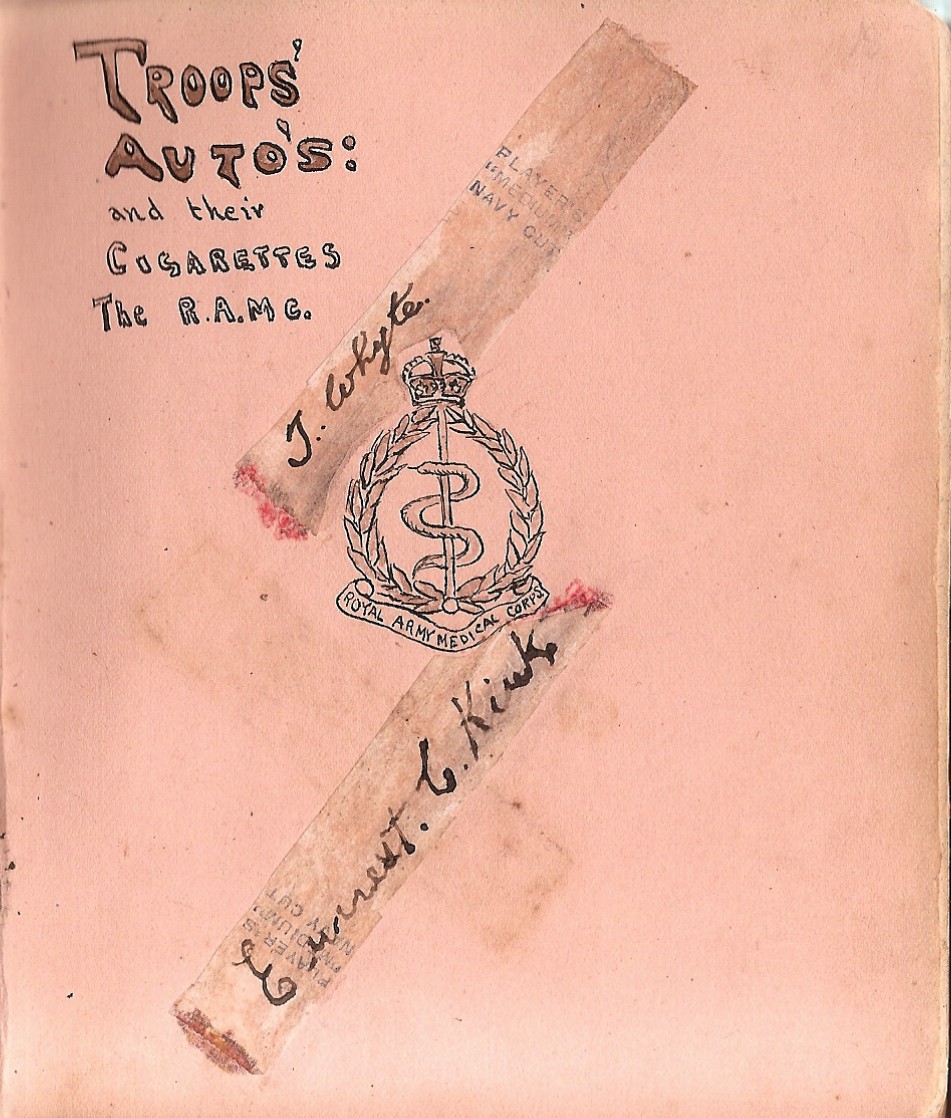
R.A.M.C Autogrphed Cigarette Papers. Red Cross Hospital. 1916.
R.A.M.C. Troop’s Autos & their Cigarette Papers. The Cenacle Red Cross Hospital. A.H.H. Autograph Album. 1916.

ramcbadge-jpg-opt155x181o00s155x181


JOHN JONES, R.A.M.C. (1) Aid Post in the Line:

LETTER to Pte HUBERT HIBBETT, The Cenacle Red Cross Hospital, New Brighton, Cheshire.

15/11/16

Dear Mr Hibbett, 

Your letter from the Cenacle to hand yesterday. I am at present one of three stationed at an aid-post in the line (2), but of course things have quietened down considerably since you were up here. We have quite a snug little dug-out, doing all our own cooking, which is so much better than depending on a cook-house. 

first-line-hospital-101-b-jpg-opt880x569o00s880x569

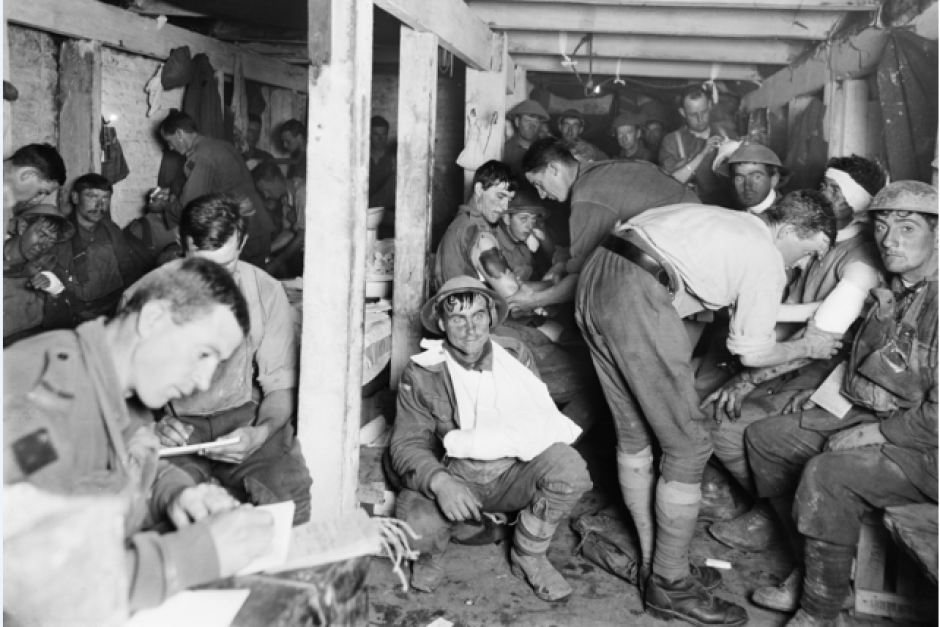
Casualties are brought down to the regiment aid-post about 20 yards from here, then we take them down to the dressing station from there.

emaze-front-line-dressing-station5581658-3x2-940x627
Front Line Dressing Station. http://www.emaze

I have not actually been stationed in the town you mention but at a hospital on the road about 2 miles towards the line. You may know where I mean.  Also at a prison dressing station (3) still further up the line.

British Soldiers carry German wounded.
British Soldiers with German wounded prisoners. Somme Offensive. July 1916.

I was pleased to hear that you were satisfied with the way the R.A.M.C. treated you out here.  Previous to operations  on the Germans (censored but decipherable (3)) people at home seemed to be under misunderstanding about the work of the R.A.M.C. out here but I think we are now given due credit for our work.

I gather that you were wounded in the arm ?( censored) (4) so you will know that we were far from idle or out of danger there (5).

New Brighton Wallesley Sands.

Certainly, my heart aches to be with you strolling along New Brighton Sands. It certainly is a fine spot for wounded to recuperate.

Our division has commenced leave (6) so I hope to see Blighty sometime before the ending of the war. I guess you don’t half enjoy those little concerts you have at the Cenacle (7).

I do not think I have anything else to write to you about this time, only it gives me great pleasure in being able to make a written acquaintance with you.  I am sure it gave mother (8) great pleasure in doing her little bit to get you better again. 

I remain,

 Yours very sincerely, John Jones* (scarcely readable signature).

**************************

ELIZABETH HIBBETT WEBB

The writer of this Letter, John Jones, R.A.M.C., was most probably a civilian doctor who volunteered for service at the Front without having to undergo extra training. He appears to be the son of Mrs M.A. Jones, one of Marie Hibbett’s best friends in Walsall. Pte Bertie Hibbett frequently mentions her kindness in sending parcels & letters to him at the Front & to the Cenacle Hospital. 

John Jones is responding to my father’s request for information about what might have happened to his brother after he was reported wounded & missing in No Man’s Land. For many months the Hibbett Family hoped Sgt Sydney Hibbett might have been taken prisoner or might simply be lost in the system. ‘I see no objection to parties with Motor Ambulances searching villages in France for the wounded & to obtain particulars of the missing & convey them to hospital’. Lord Kitchener.12th Sept. 1914. 
Asclepius

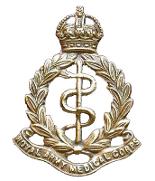
(1) R.A.M.C. Badge has the Rod of Asclepius (with serpent  symbol of life & healing) surmounted by a crown, within a laurel wreath (symbols of honour & victory) with the regimental motto ‘In Arduis Fidelis‘ (Faithful in Adversity) or ‘Royal Army Medical Corps’ in a scroll beneath.  Asclepius was a Greek Hero & God of Medicine, (<www.GreekMedicine.net>).  R.A.M.C. medics wore an arm band but carried no weapon or ammunition. ramc-badge-jpg-opt150x144o00s150x144

(2) Aid Post in the Line: the first in a chain of medical posts organised by the Field Ambulance (FA). The FA Bearer Division brought wounded from the Front Line Regimental Aid Post (RAP) to a Casualty Clearing Station (CCS), then on to a Main Dressing Station MDS (Tented ‘Hospital’) for treatment by the FA Tent Division. At the outbreak of war the R.A.M.C. had only 5,000 officers & men.

Lt general Sir Alfred Kogh 1857 -1936.
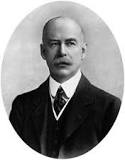
Lt General Sir Alfred Keogh 1857 -1936.

After the Battle of Mons, 23rd Aug 1914, when many wounded died in the chaos for lack of transport & swift medical support, (Doctor) Sir Alfred Henry Keogh was appointed Director General of R.A.M.C. & completely re-organised it. 

first-line-hospital-101-b-jpg-opt880x569o00s880x569

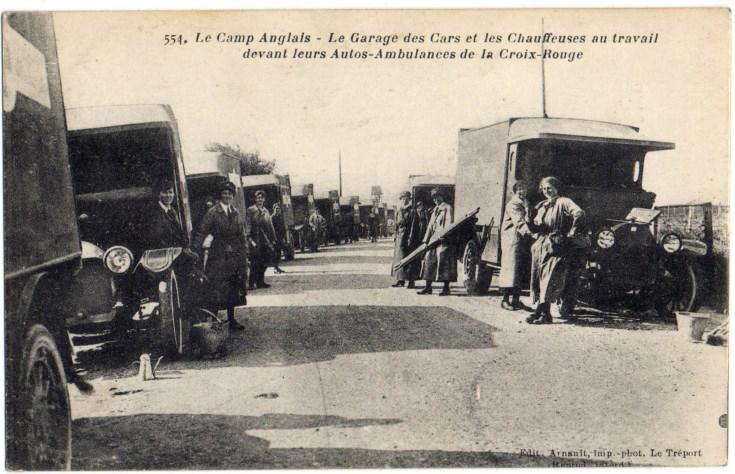
A massive fund-raising scheme to purchase motor ambulances took place. Many women acted as ambulance drivers & motor mechanics.

Women Drivers.
354. The English Camp -The Garage of Cars & Women Drivers (& Mechanics) at work in front of their  Red Cross Motor-Ambulances. Le Treport. 1916.
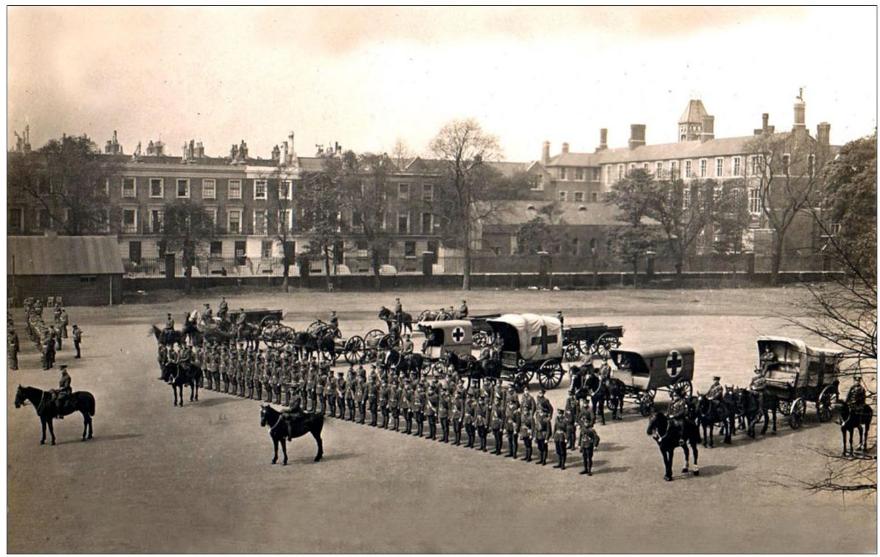
Field Ambulance on Parade. Location unknown
Field Ambulance Unit on Parade. Location unknown.jpg.opt.

A Field Ambulance Unit consisted of 10 Officers, 224 Other Ranks & Army Service Corps. ‘Each column consisted of ambulance wagons, water-carts, forage carts for stores, cook’s wagon, 52 riding & draught horses’ and a member of the Cycle Corps.  cf Hibbett Letters: 14th Dec. 1915 and <https://www.1914-1918.net/fieldambulances&gt;

Grateful thanks to Tony Allen for his excellent website “The Royal Army Medical Corps on WW1 Postcards <https://www.worldwar1postcards.com/war-wounded-and-the-ramc.php> It is full of information, well researched, clearly presented with numerous illustrations.

(3) German Wounded Prisoners: the R.A.M.C.’s humanitarian aim was to treat British & German wounded alike, according to the Geneva Convention of 1864: ‘Wounded & sick combatants, to whatever nation they may belong, shall be collected & cared for’. ‘Operations on the Germans’: i.e the Battle of Somme/Gommecourt (not medical operations).

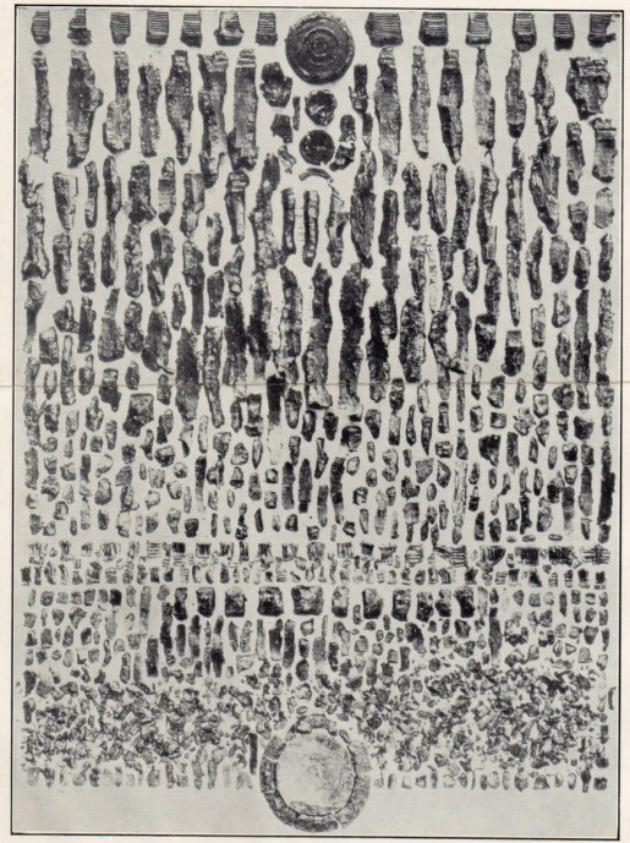
frg-of-18-pdr-mark-iii-shell-complete-detonationfragmentation-4-this-one-jpg-opt630x843o00s630x843
Fragmentation of 18 pounder Mark iii Shell (complete detonation). Courtesy Tony Allen.

(4) Pte Bertie’s Wound: a three-letter word (‘arm‘?) has been censored to prevent the enemy learning the effect of its shells. The R.A.M.C contributed to WW1 research into types of wounds caused by fragmentation of shells. One of these such fragments nearly cost my Dad his arm.

(5) ‘Out there’: ie Foncquevillers Church Crypt Field Dressing Station (where my father had his wound dressed & received anti-tetanus injection 1st July 1916).  If the Germans had counter-attacked the medics there might well have been taken prisoner as the FDS in the Church Crypt was so close to the Front Line.

(6) Division Commenced Leave: Leave had dried up since June  prior to Battle of Somme 1st July 1916 (i.e. nearly 6 months). See Hibbett Cartoon & Letter: 6th June 1916.

(7) Cenacle Patients’ Concerts: See Hibbett Letters: 4th Oct 1916 & 10th Nov. 1916.

(8) MotherMrs M.A.Jones, attended St Paul’s Church Walsall (wife of J.H.Jones on Walsall Education Committee? / called him ‘His Lordship’ 20th June 1915;12th & 13th Sept. 1915). Many refs in Hibbett Letters to her parcels & letters. Mother of Lance Corp. A.O.Jones to whom Sydney entrusted his pack should anything happen to him. See Hibbett Letters: 17th May 1915; 27th Feb. 1916;10th & 21st May 1916; 1st June 1916; 19th July 1916.

NEXT POST: 20th Nov. 1916. ‘I dreamt a dream last night . . . Sydney on a Charger  . . . helmet covered with leaves’.

10th NOV. 1916: ‘THE CLIMATE OVER IN FLANDERS IS TOO BLOOMIN’ HOT’

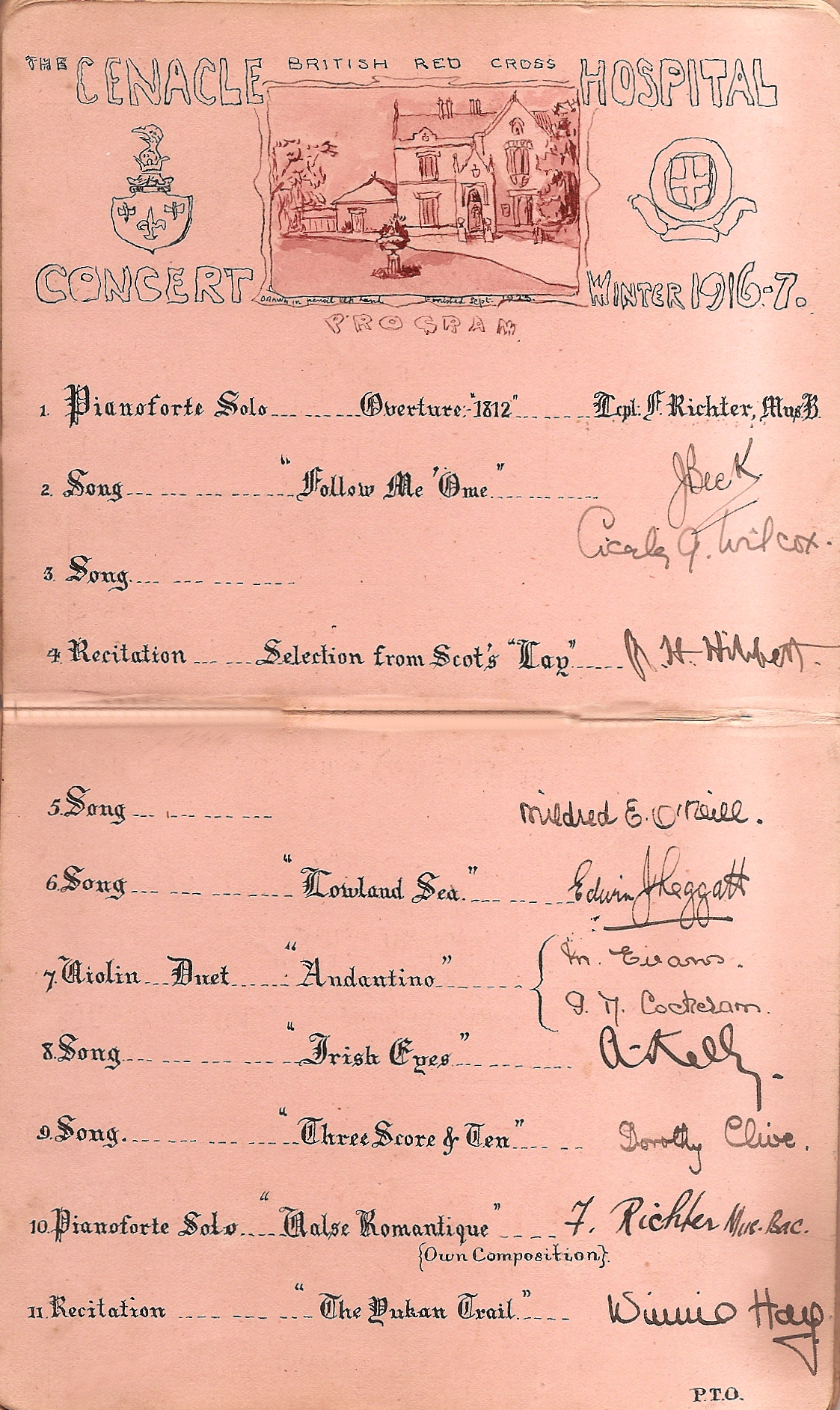
Concert Programme

2nd-cenacle-concert-part-2Transcription: The Cenacle British Red Cross Hospital  Concert. Winter 1916-17. Program. Sketch drawn in pencil. Finished 1923.

1) Pianoforte Solo:  “Overture 1812″. Tchaikovsky. 1882. Piano arrangement 1882. Lance Corpl F. Richter. Mus B. (Bachelor of Music).

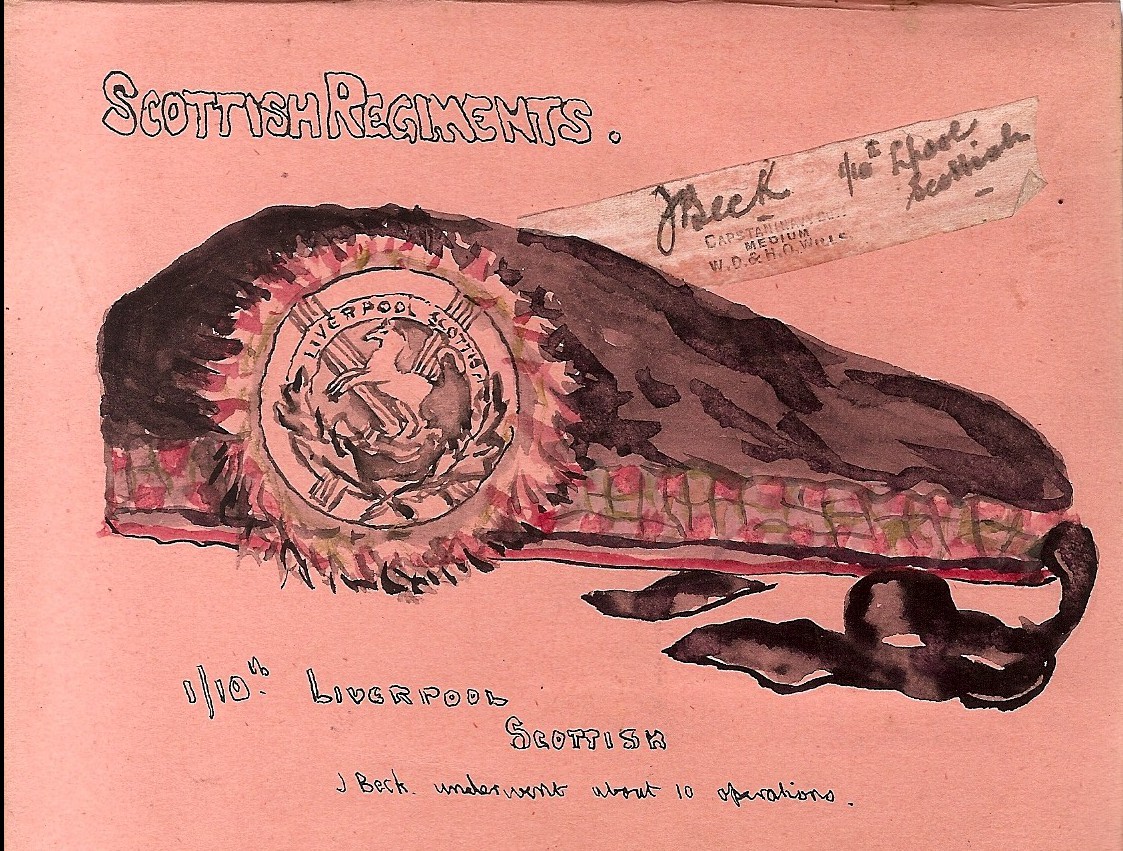
2) Song: “Follow me ‘Ome”. Rudyard Kipling, 1865 -1936. ‘There was no one like ‘im ‘Orse or Foot Nor any o’ the Guns I knew; An’ because it was so, why o’ course ‘e went an’ died. Which is just what the best men do. So knock out your pipes an’ follow me. An’ it’s finish up your swipes an’ follow me. Oh ‘ark to the big drum callin’ Follow me – Follow me ‘Ome. Corporal J. Beck. 1/10th Liverpool Scottish. (Underwent 10 operations) .

Corpral Beck
Cpl. Beck

SCOTTISH REGIMENTS.


3. Song: Nurse Cicely G. Wilcox.

4. Recitation: Selection “The Lay of the Last Minstrel“. Bertie Hibbett1805. Sir Walter Scot. Romantic/Gothic story of 16th Cent Border Feud/ theme-loyalty to one’s homeland. Pte A. H.Hibbett 1/5th S. Staffs.

5. Song: Nurse Mildred E. O’Neill.

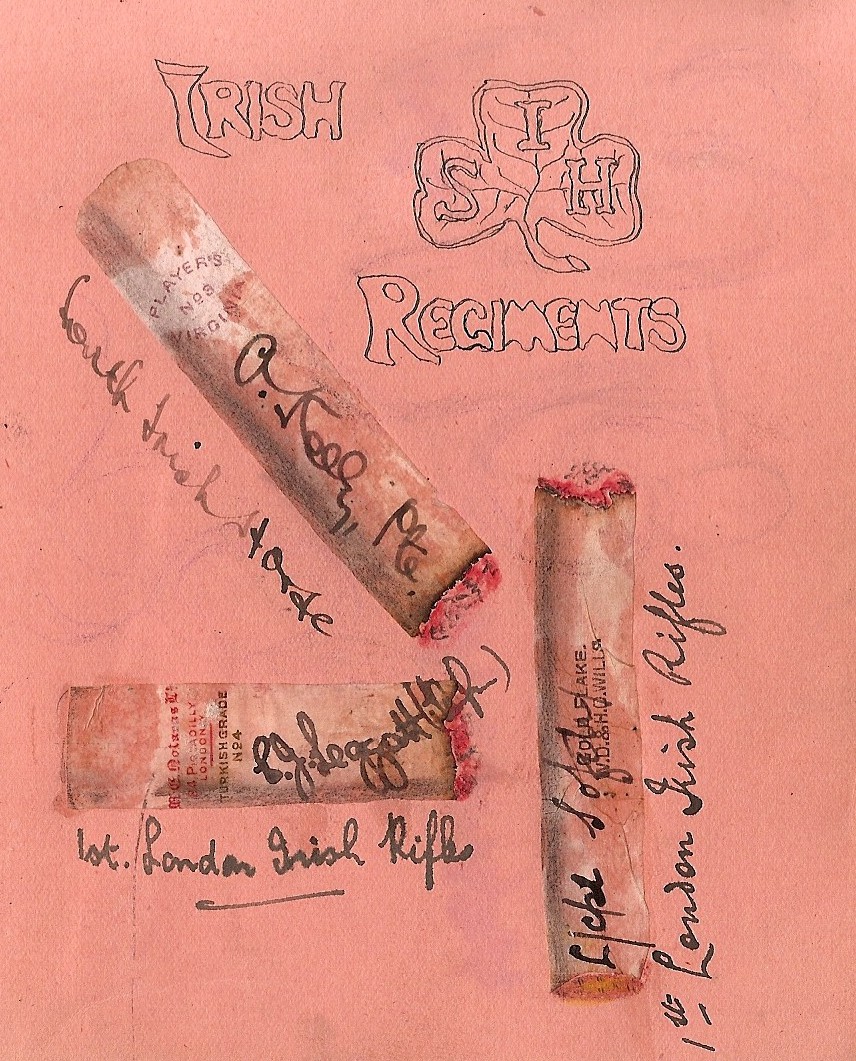
Irish regiment Autographs collected on Cigarette ppares . Hsopital Birkenhead. 1916.
Cigarette Autos: Pte A Kelly & Rfle E. J. Leggett.

6. Song: “Lowland Sea“. The Golden Vanity’s Cabin Boy was promised silver & gold to sink a Spanish galleon, successful but betrayed & left to drown. 17th Cent Battle between Spain & England. Rifleman Edwin J. Leggett. 1st London Irish Rifles.

Cenacle Red Cross Nurse Cockeram.
Cockeram.

7. Violin Duet: Andantino“. Shin’ichi Suzuki, 1898 -1998. Japanese inventor of Suzuki method. Taught self to play violin in 1916! Nurse M. Evans & Nurse G. M. Cockeram.

Nurse G. Cockeram. 12th April 1917.
G. Cockeram’s Blindfold Pig. 12th April 1917.

8. Song: When Irish Eyes are Smiling from Olcott’s ‘Isle of Dreams’ 1912. Lyrics: Chauncey Olcott & George Graff Jr.  Tune: Ernest Ball. 1878 -1927. Pte A. Kelly. South Irish Horse.

9. Song: Three Score & Ten“. (Source unknown. Biblical span of  human life). Sister Dorothy Clive. 

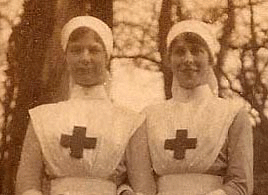
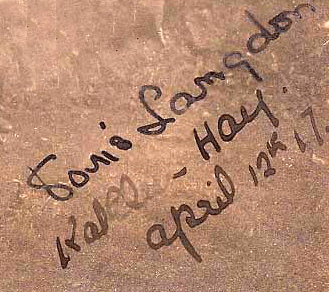
Red Cross Nurses: Sonia Langdon & Kathleen Hay 1916.
Red Cross Nurses: Sonia Langdon & Kathleen Hay  (Winnnie Hay’s sister) 1916.

10. Pianoforte Solo: Walse Romantique“. Own Composition, L/Corporal F. Richter. Mus Bac.

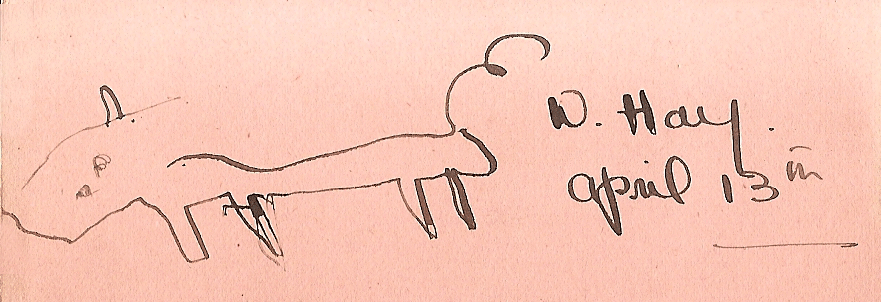
Nurse W.Hay's Blindfold Pis & Signature.
Winnie Hay’s Blindfold Pig & Signature.April 13th 1917.

11. Recitation:The Yukon Trail“. Hamid Kareem? (nationality/date unknown). ‘To Yukon for gold they went, they left in poverty & death they found. ‘Twas no gold but iron ore. . . fool’s gold. Yukon was but a fool’s paradise’. Nurse Winnie Hay. 

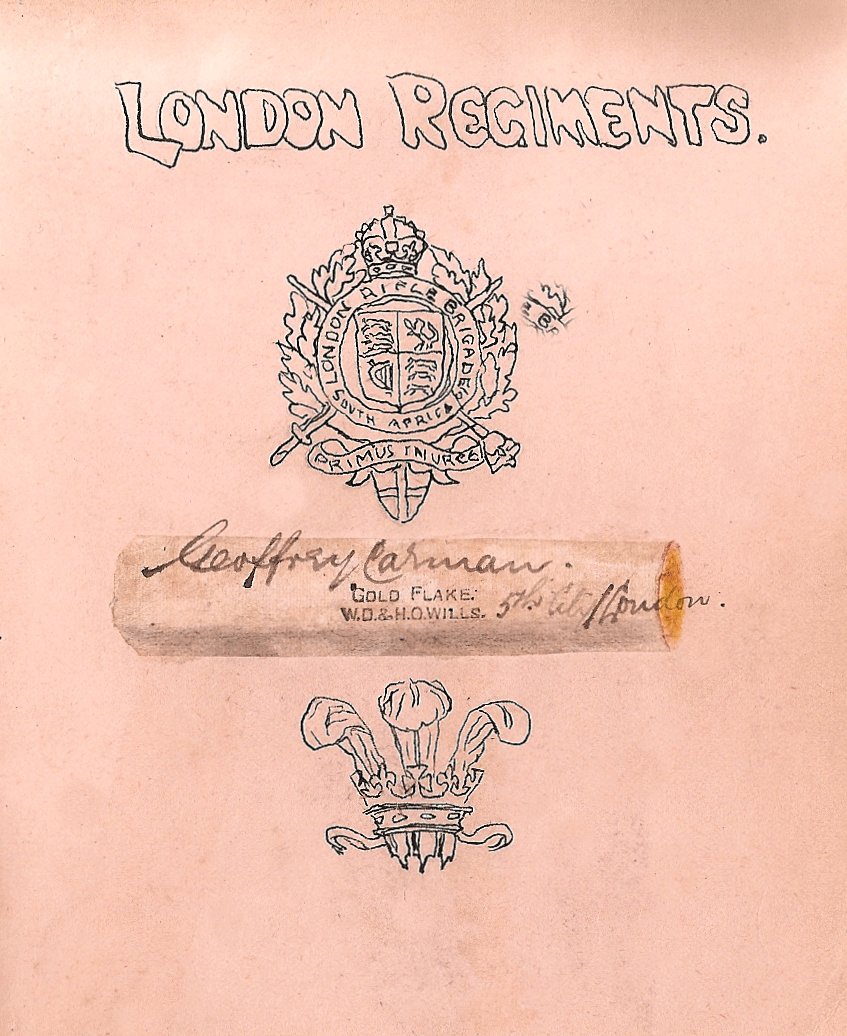
Geoffrey
Geoffrey Carman’s Cigarette Paper & Signature.

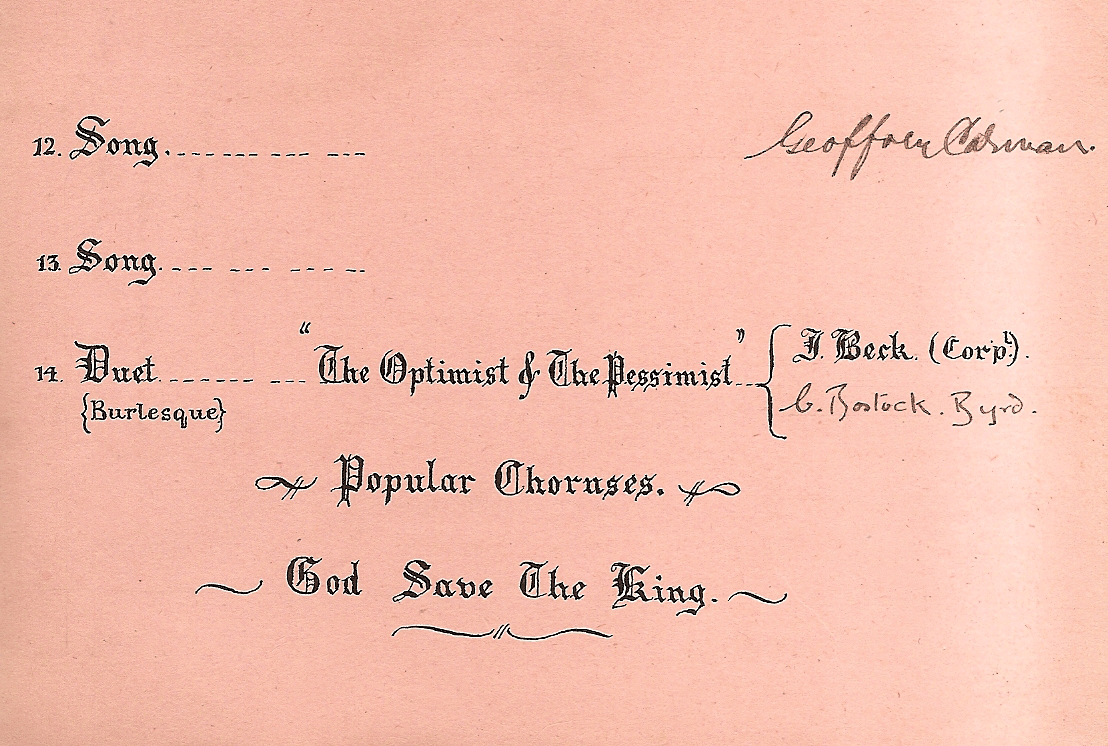
12. Song: Geoffrey Carman. 5th City London Regiment. 

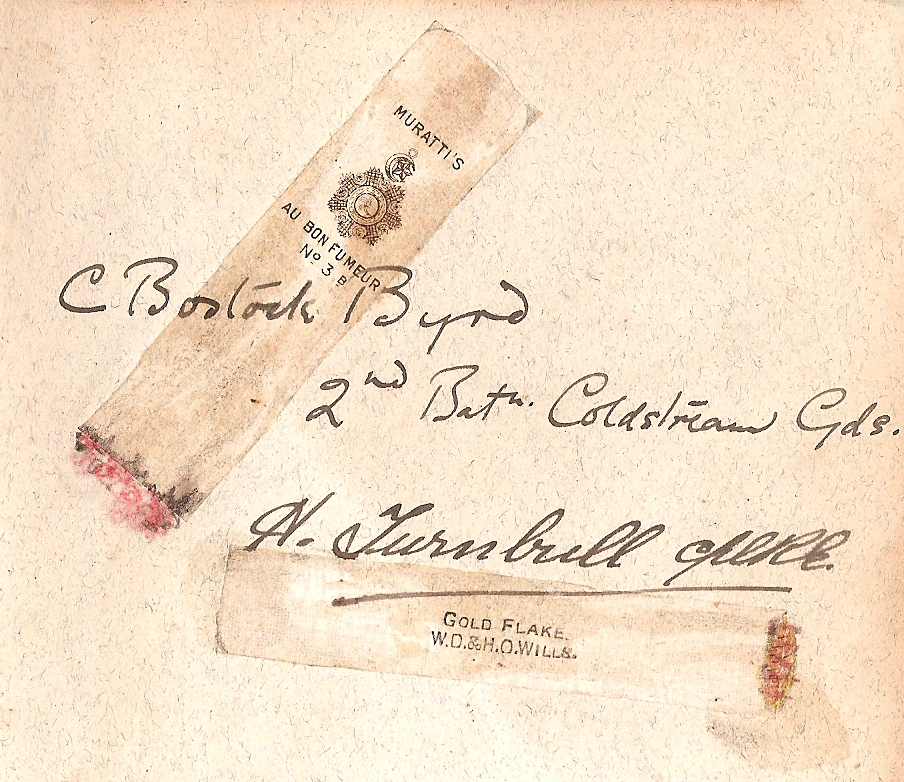
Corp. Bostock Byrd.

bostock-byrd-turnbull-cigs-sigs
Byrd’s Signature.


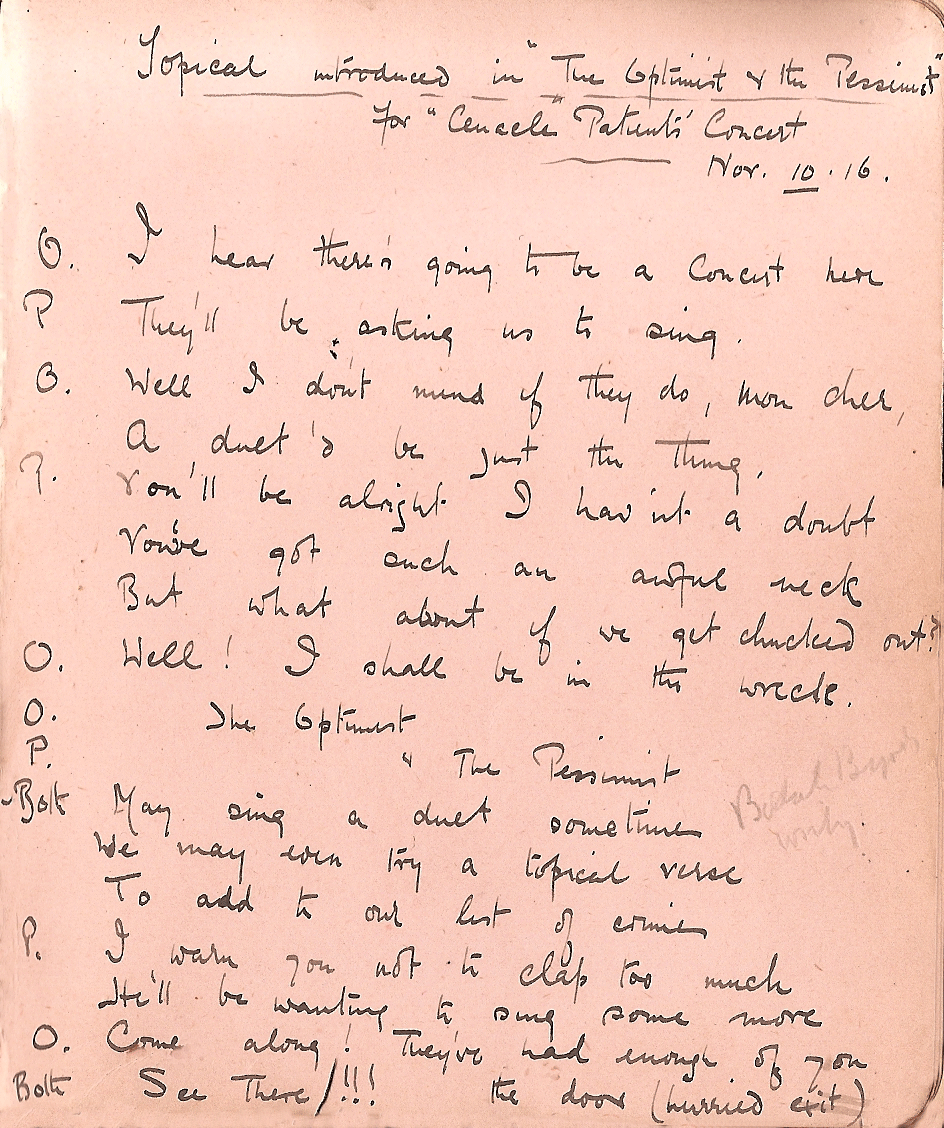
14. Duet Burlesque: The Optimist & The Pessimist“. Own composition. Corporal J. Beck (see Song 2) performed with Corporal G. Bostock-Byrd. 2nd Bn Coldstream Guards.

optimist-pessimist-2

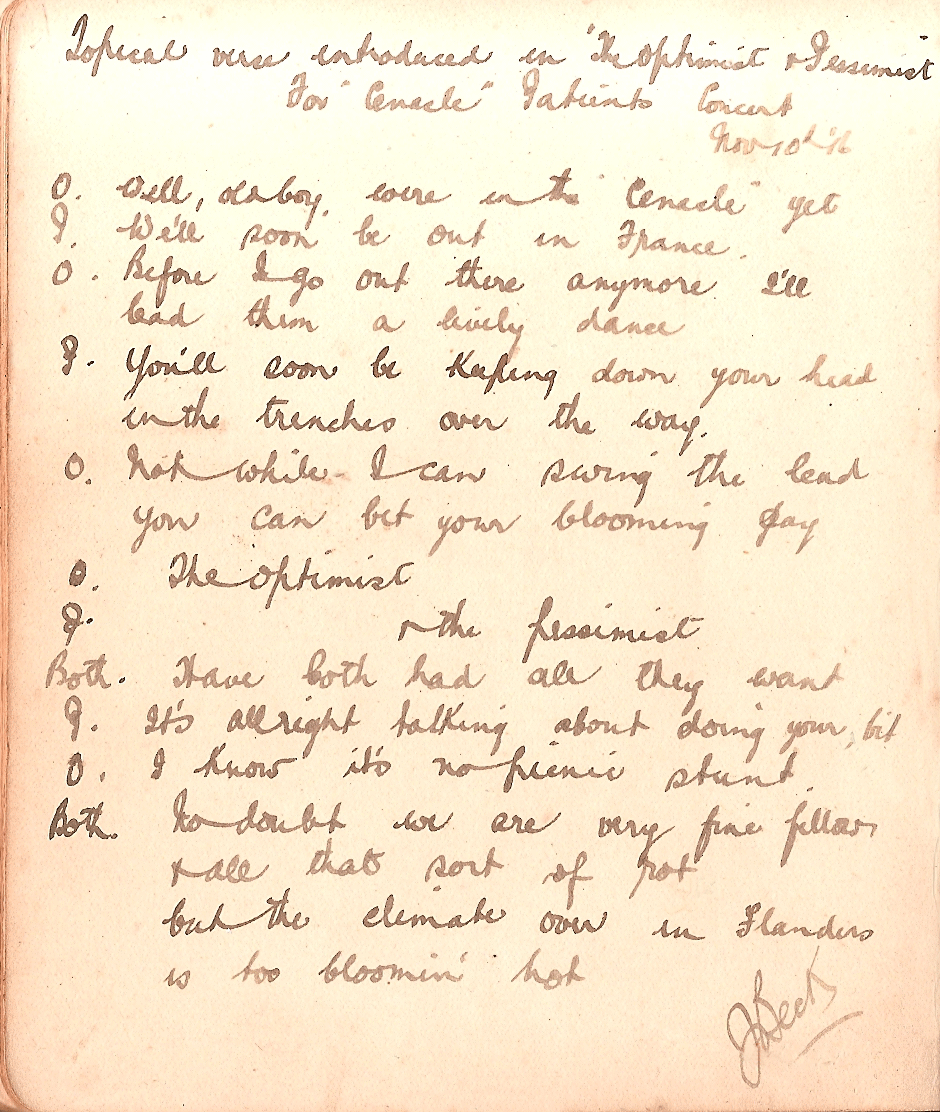
Transcript: Topical Verse introduced in “The Optimist & the Pessimist For “Cenacle” Patients’ Concert. Nov. 10.16.

Optimist: I hear there’s going to be a Concert here. Pessimist: They’ll be asking us to sing. O: Well I don’t mind if they do, mon cher, a duet ‘d be just the thing. P: You’ll be alright I havn’t a doubt. You’ve got such an awful neck. But what about if we get chucked out? O: Well! I shall be in the wreck. O: The Optimist. P: & The Pessimist. Both: may sing a duet sometime. We may even try a topical verse To add to our list of crimes. P: I warn you not to clap too much. He’ll be wanting to sing some more. O: O come along! They’ve had enough of you. Both: So There!!!  The door (hurried exit).

optimist-pessimist-10th-nov-1916

Transcript: Topical Verse introduced in “The Optimist & The Pessimist” For “Cenacle” Patients’ Concert. Nov 10th 16.

Optimist: Well old boy, we’re in the Cenacle yet. Pessimist: We’ll soon be out in France. O: before I go out there anymore I’ll lead them a lively dance. P: You’ll soon be keeping down your head in the trenches over the way. O: Not while I can swing the lead you can bet your blooming pay. O: The Optimist. P. & The Pessimist. Both: Have both had all they want. P: It’s all right talking about doing your bit. O: I know it’s no picnic stunt. Both: No doubt we are very fine fellers & all that sort of pot but the climate over in Flanders is too bloomin’ hot. J. Beck.

**********************

ELIZABETH HIBBETT WEBB

This second Patients’ Concert  at the Cenacle provides another good example of the artistic talent amongst soldiers & nurses alike. (cf 4th Oct. Concert).

“The Optimist & The Pessimist” by Corp. J. Beck 1/10th Liverpool Scottish is a grim reminder that all the wounded at the Cenacle Red Cross Hospital, including my father, obviously wanted to get better but were under the threat of being sent back to the Front as soon as they were.

My Father’s 21st Birthday Autograph Album has been a most valuable source of information when trying to identify people in the Hibbett Collection of Photographs. He illustrates the signed cigarette papers giving details of regt & rank & adding little notes e.g. Corpl Beck’s ’10 operations’. That so many nurses had some fun on 12th/13th April1917, indicates he was close to leaving Hospital. Their amusing drawings of a pig  (with their eyes closed) giving signature & date solves the problem of just how long my Father spent at the Cenacle. His 1967 My Memories of the First World War’ states it was seven months but now we know it was at least ten months.

NEXT POST: 15th NOV. 1916.  ‘R.A.M.C Operations on Wounded German Prisoners’.  NB This post may be late. I hope to remember my Uncle Sydney & Aunt Ida this Remembrance Sunday at Walsall War Memorial, also at the National Memorial Arboretum. 

6TH NOV.1916: ‘THE GRAMMAR SCHOOL FLAG WILL BE FLYING AT HALF MAST TOMORROW FOR DEAR SYDNEY’.

.Champion Ida Hibbett VAD Nurse.
Ida Hibbett .

IDA NEAL HIBBETT, Red Cross VAD Nurse,95, Foden Rd Walsall: POSTCARD to Pte BERTIE HIBBETT, British Red  Cross Hospital, The Cenacle, St George’s Mount, New Brighton, Cheshire.

Nov 6th. Monday.

The Grammar School Flag will be flying at half mast tomorrow (Tuesday) for dear Sydney.  We will send Mr Marshall’s letter for you to read, when we send the parcel.  I will write tomorrow.   Love – Ida.

Queen Mary's Grammar School Walsall.
Queen Mary’s Grammar School Walsall.1909.
ELIZABETH HIBBETT WEBB
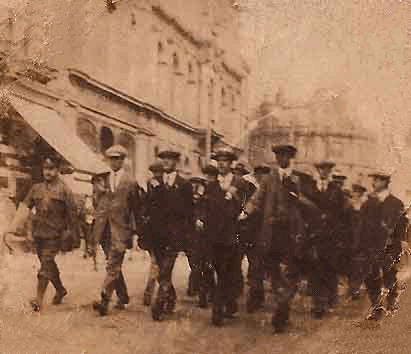
Pte Bertie Hibbett is marching behind his brother Sydney (in mufti, front row far left). Bridge Street, Walsall. Sept. 1914.
Sydney Hibbett marching down Bridge Street in the front row left, with his brother immediately behind him. 4th Sept.1914.

SERJEANT SYDNEY HIBBETT: 1/5th South Staffordshire Regt. Missing Killed in Action 1st July 1916 aged 22. Born Nottingham, 17th May, 1894, second son of Arthur  & Marie Neal Hibbett. Attended Blue Coat’s SchoolQueen Mary’s Grammar School, Walsall. O.T.C. Cadet. Mining Engineer. Enlisted Walsall 2nd Sept.1914. Marched down Bridge Street en route to Station & training in Bedfordshire. 4th Sept. 1914. 

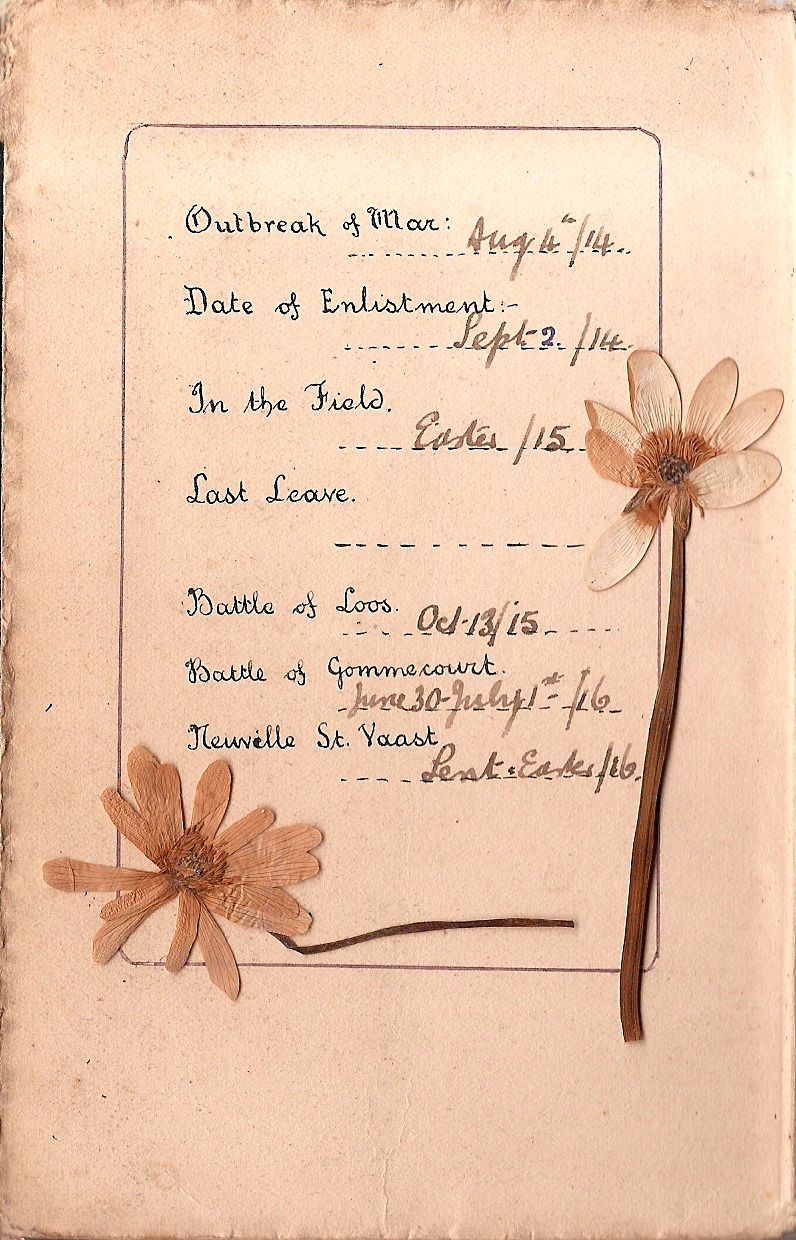
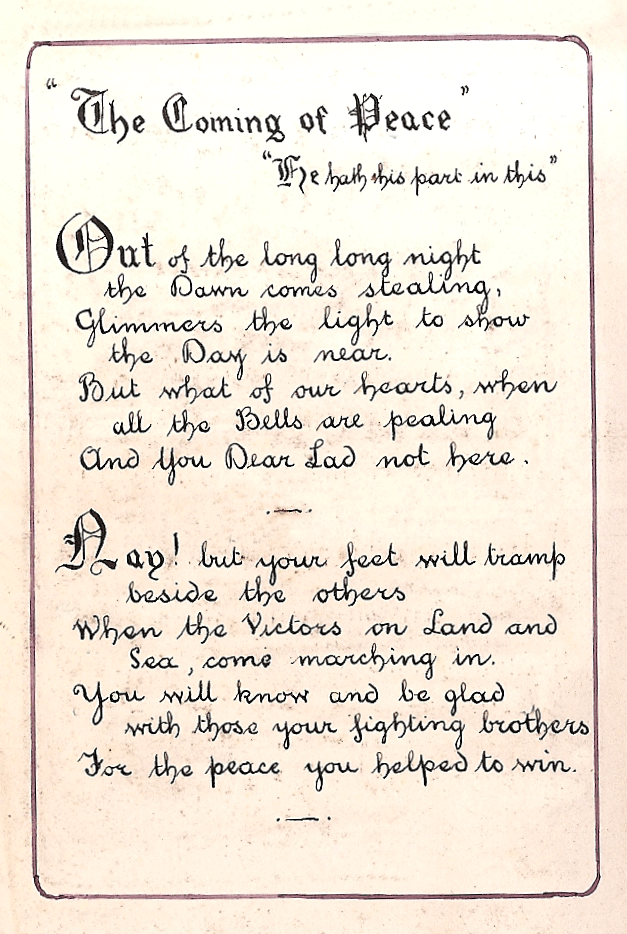
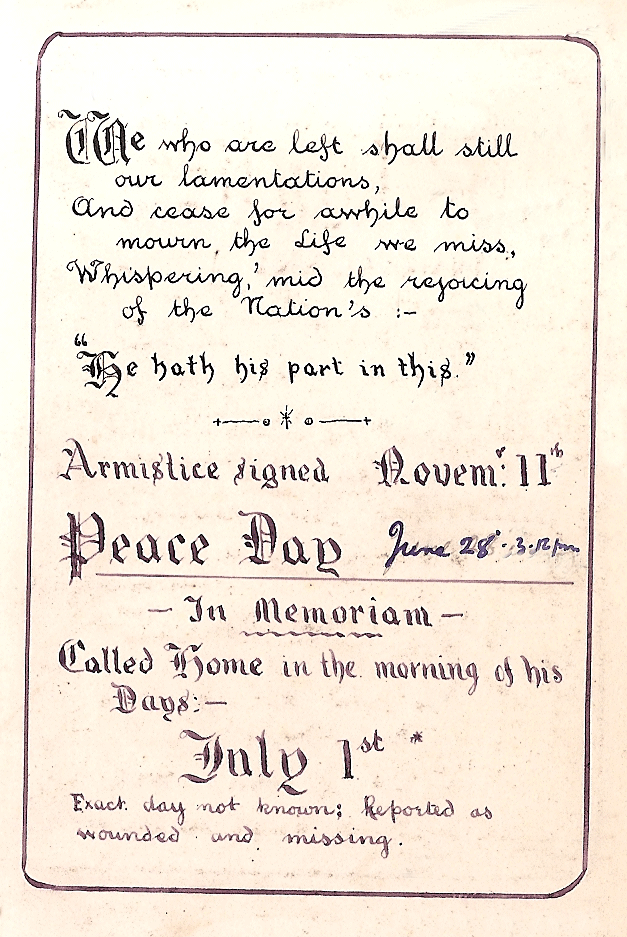
remembrance-days-half-coverremembrance-days-page-1For the whole of the rest of his life my father, Bertie Hibbett, made sure his brother was not forgotten. He designed his little Remembrance Days Book © and painted Sydney’s portrait in oils, between 1917 & 1920.

Remembrance Days p 3.

Remembrance Days.
Remembrance Days. Illustrated in water-colour & scripted: A.H.H. 1917 -1920

Transcript:  “The Coming of Peace”  “He hath his part in this” .

Out of the long long night the Dawn comes stealing, Glimmers the light to show the Day is near. But what of our hearts, when all the Bells are pealing And You Dear Lad not here.

Nay! but your feet will tramp beside the others When the Victors on Land and Sea, come marching in. You will know and be glad with those your fighting brothers For the peace you helped to win.

We who are Left shall still our lamentations, And cease for awhile to mourn the Life we miss. Whispering ‘mid the rejoicing of the Nation’s: “He hath his part in this.”  (author unknown)                              

Armistice signed Novem’. 11th. (1918).  PEACE DAY June 28th 3.12 pm (Ed. 1919 at Treaty of Versailles, exactly 5 yrs after Assassination of Archduke Ferdinand).  In Memoriam. Called Home in the morning of his Days:- July 1st 1916. * Exact day not known; reported as wounded & missing.’

*****************************

Marshall. Headmaster QMS 1906 -1926.
Edward Norman Marshall. Headmaster QMS 1906 -1926.

The Headmaster of Queen Mary’s Grammar School, Edward Norman Marshall, was one of the most respected & influential of QMS Headmasters. See QMS Magazine on his Retirement in 1926. He was a personal friend to my grandfather Arthur Hibbett (Director of Education) and supported the Family throughout the War. His was the fateful Postcard that recruited his Old Boys into the Army in Aug. 1914. See Hibbett Letters: 10th August 1914.

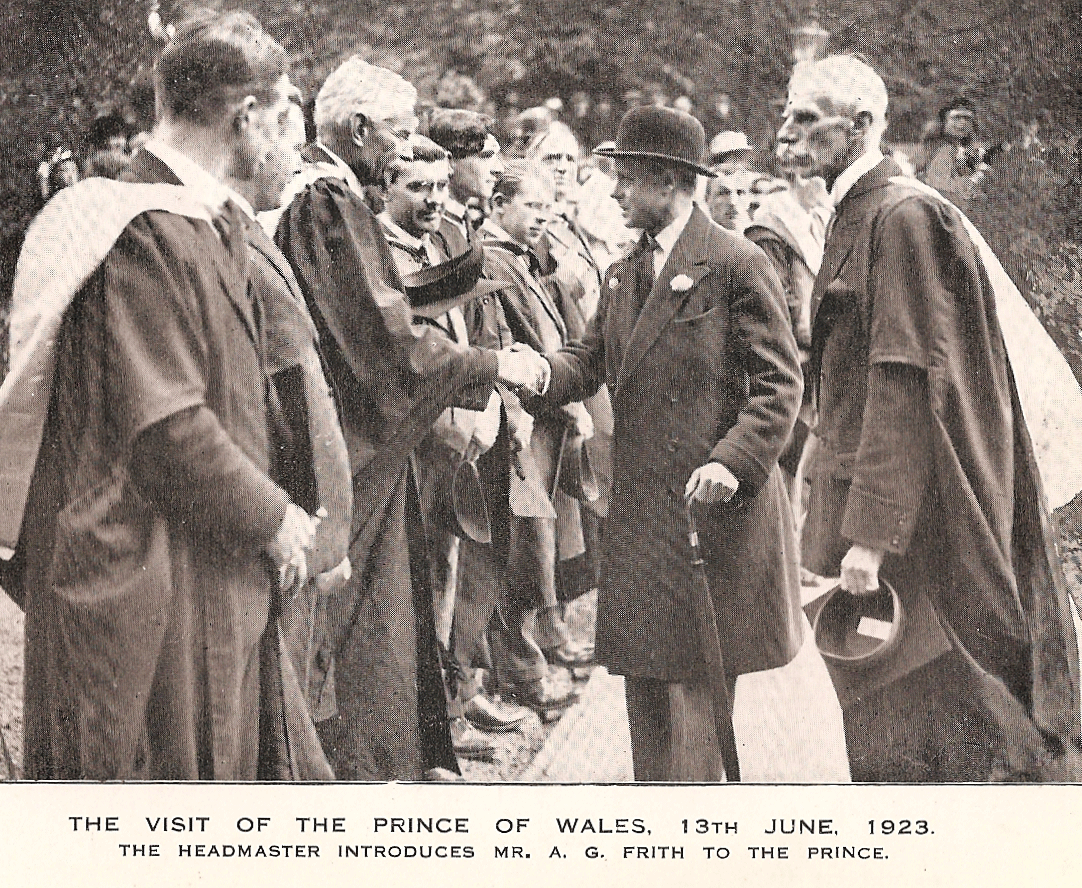
Prince of Wales Visit to QMS. 1920?

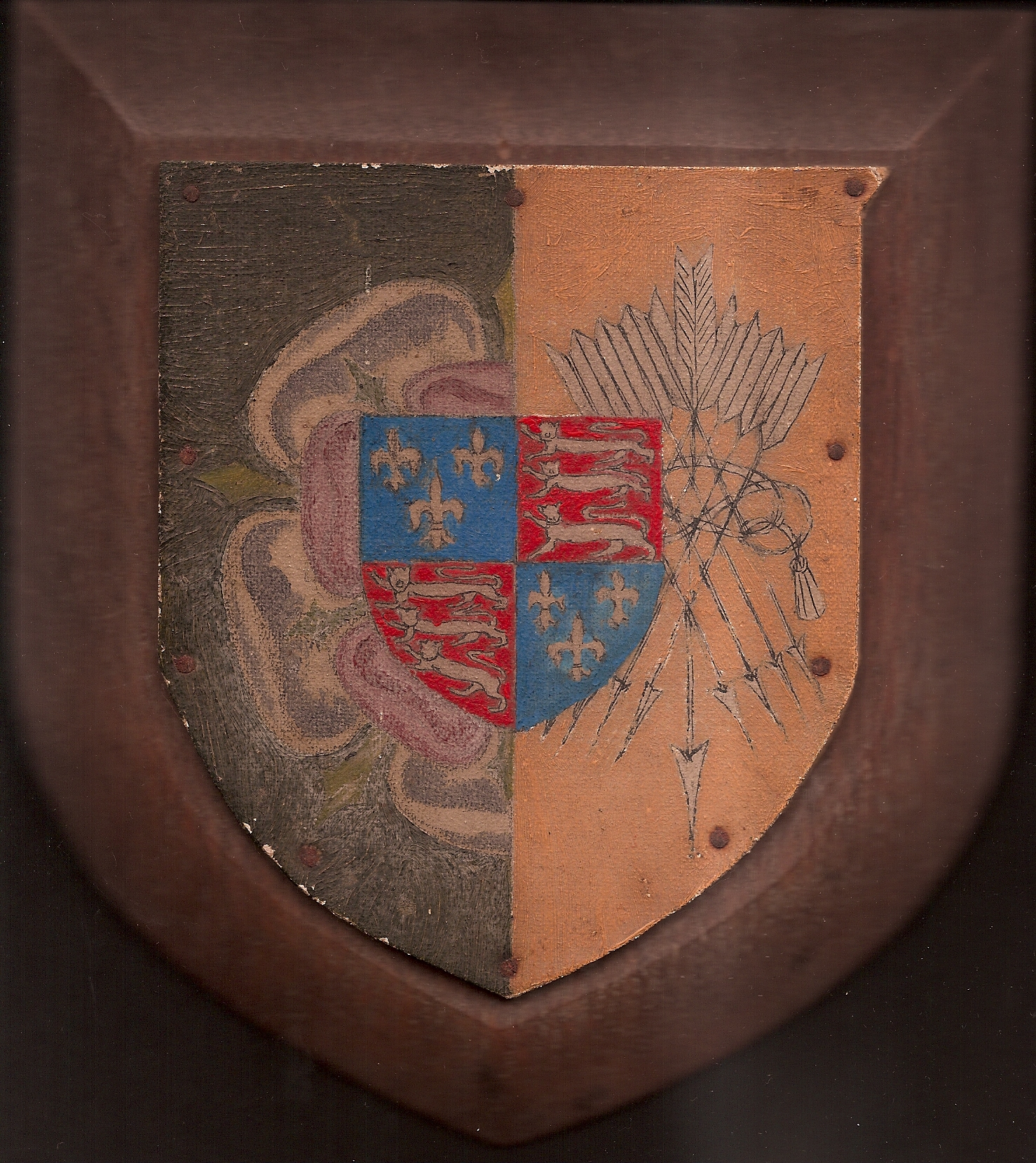
QMS Life Membership Club
QMS Life Membership Shield. A.H.H. 1923.

The Grammar School Flag would no doubt have flown during the Prince of Wales’ Visit.  It must have been the Union Jack  (unless one with the heraldic design of the QMS Badge & Life Membership Shield was used?) See Hibbett Letters for QMS symbolism: 12th Jan 1915. Mr A. G. Frith* MA, was Classics Master & Frith House Master at QMS. (Exhibitioner, Sydney Sussex College, Cambridge).

It was a measure of the importance of the Grammar School to my father that he became Queen Mary’s Club Life Member No 392 in 1926; two guineas (42 shillings) would have been a considerable sum on his curate’s salary. 

Quenn mary's Club. Life membership. Received Rev A.H.Hibbett
Queen Mary’s Club. Life membership. Received from Rev A.H.Hibbett two guineas, being the Subscription for Life Membership of Queen Mary’s Club. Date 4. March. 1926. Initials E.N.M. across two George 5th penny stamps. Signed E.N. Marshall. President.

From the time he became a priest in 1924 until his retirement, my father led Armistice Day Remembrance Services. He placed Poppy Crosses at the War Memorial, inscribed with the name of his brother Sydney and his sister Ida d.1921, his eldest brother Harold, d.1940 & youngest brother Basil d 1967: all died from wounds inflicted in the First World War. One of my earliest memories  is being seated on the cross-bar of my Dad’s ‘rattley’ old bike, a basket of Earl Haig Fund poppies in front, as he cycled from farm-stead to scattered  farm-stead in the parishes of Tathwell with Haugham.

This year, with my poppy crosses, I hope to attend the Remembrance Day Service at Walsall’s War Memorial. (Designed in local limestone by H. H. Martyn & Co the Memorial on Bridge Street was unveiled 1st Oct. 1921).

NEXT POST: 10th Nov. 1916. Another Concert at the Cenacle Hospital.

23RD OCT: BRITISH RED CROSS ENQUIRY: ‘A VERY SAD REPORT ABOUT YOUR SON’.

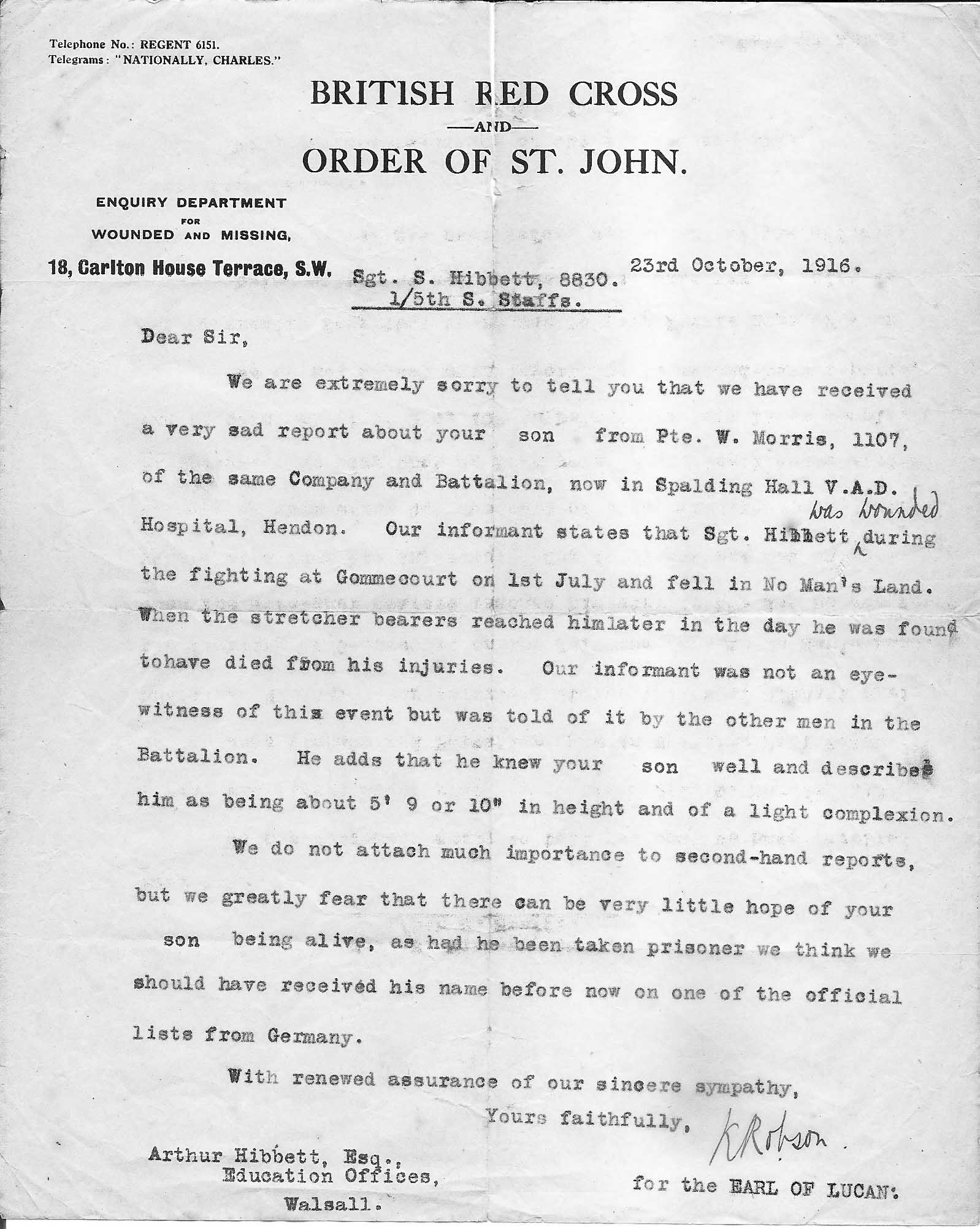
BRITISH RED CROSS & ORDER OF ST.JOHN  Enquiry Department for Wounded & Missing: LETTER to ARTHUR HIBBETT Esq. Education Offices, Walsall (1).

Red Cross Letter18, Carlton House Terrace, S.W.  (2)                       23rd October, 1916.                                                                                                                                                                     Dear Sir,    

Sgt. S. Hibbett  8830 1/5th S Staffs

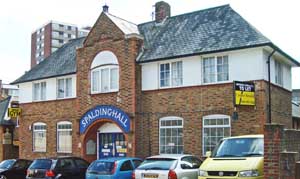
We are extremely sorry to tell you that we have received a very sad report about your son from Pte W. Morris*, 1107, of the same Company and Battalion, now in Spalding Hall V.A.D. Hospital, Hendon (3).

Our information states that Sgt Hibbett was wounded during the fighting at Gommecourt on 1stJuly and fell in No Man’s Land.  When the stretcher bearers reached him later in the day he was found to have died of his injuries.  Our informant was not an eye-witness of this event but was told of it by the other men in the Battalion.

He adds that he knew your son well and described him as being about 5’ 9 or 10” in height and of a light complexion (4).

We do not attach much importance to second-hand reports but we greatly fear that there can be very little hope of your son being alive, as had he been taken prisoner we think we should have received his name before now on one of the official lists from Germany (5).

With renewed assurance of our sincere sympathy,

Yours faithfully,                    K. Robson for the Earl of Lucan (6).

Arthur Hibbett, Education Offices, Walsall.

***************************

ELIZABETH HIBBETT WEBB

In the four months after 1st July, the first day of the Battle for the Somme, the Hibbett Family had heard nothing about Serjeant Sydney Hibbett’s whereabouts, except informal verbal reports that he had fallen in No Man’s Land opposite Gommecourt Wood. [See my father’s Memories of the First World War; Letters from H.E.Bird, QMS Chaplain, 1/5th Staffords/19.7.1916; Sgt W.Gried(sp?) 17.8.1916; ‘Your Old Pal Ben’/19.9.1916]. 

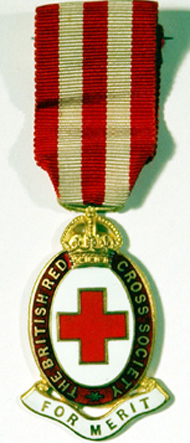
british-red-cross-merit-badge-w1901This Letter from the Red Cross was obviously in answer to one from Arthur Hibbett giving details of his son’s rank, height & complexion, and asking whether he had been taken prisoner. Sadly the Red Cross news was still second-hand. No eyewitness evidence had yet come forward. The Family had to wait nearly three years before they received official notice from the War Office that Sydney Hibbett was ‘Missing Presumed Killed in Action’ and a further year or more before they found what is ‘believed to be’ his grave.

NB. This Letter is an example of a War Office directive to discard official forms when answering enquiries, so that families might feel ‘a personal interest was being taken’ in their loved one.

(1) Education Offices, Walsall. No doubt in order to protect their Mother from receiving distressing news at 95, Foden Road, Bertie Hibbett & his brother had arranged for War Office Letters to be sent to their Father, Arthur Hibbett, Chief Education Officer for the Borough of Walsall. 

Carlton House Terrace.
Carlton House Terrace, near Trafalgar Square, London.

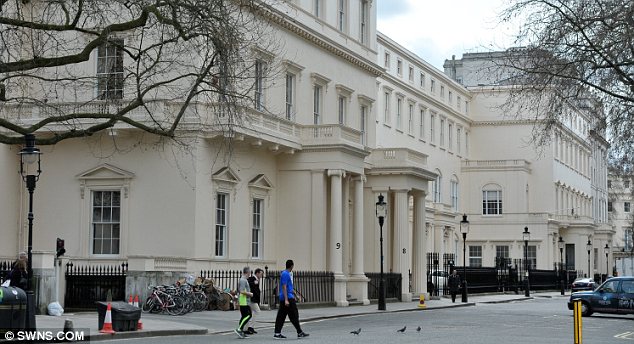
(2) Carlton House Terrace: Regency Mansion Grade 1 Listed. Lent by Lord Astor to Red Cross for duration of War. (Terrace also housed Lady Ridley’s Hospital). (Sold in 2013 for £250 million/’ size of football pitch’).

In 1914 the British Red Cross formed the Joint War Committee with the Order of St John.  Lord Robert Cecil (London Branch of Red Cross) established the Department for Missing & Wounded Enquiry Services. Regulated by the War Office, the Red Cross was declared the only organisation permitted to enquire of the Missing. See <https://www.redcross.org.uk&gt;  Offices were set up at 83, Pall Mall; then 20, Arlington Street (lent by Lord Salisbury); later in July 1915 at Norfolk House, St James Square. Offices were also set up in Paris, Bologne, Rouen, Malta, Alexandria & Salonica to liaise with Base Hospitals & Army Rest Camps).  In July 1916 during the Battle of the Somme the Department began searching for all soldiers reported Missing whether or not friends & relatives had made enquiries. Monthly Enquiry Lists were made. A total of 342,248 enquiries were dealt with.

Spalding Hall Hendon.
Spalding Hall, Hendon. <https://www.losthospitals of london>

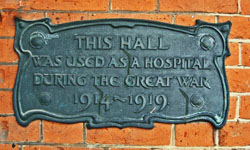
(3) Spalding Hall VAD Hospital, Hendon: Convalescent Military Hospital, 1915 -1919. Given for duration of the War by Hendon Congregational Church, Dec. 1914. Opened 1915 with 20 beds; run by local Middlesex/16 Voluntary Aid Detachment, VAD. [Named after Thomas Spalding founder member of Hendon Congregationalists].spaldinghall2

(4) Sydney Hibbett’s height: in the absence of Army Enlistment details this is useful personal detail.

german-red-cross-8d1fac9d861da0a332f7d24538861c8e

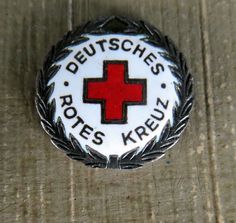
   (5) Prisoners: Lists of captured British Soldiers were received direct from Germany through the Frankfurt Red Cross. Repatriated prisoners were sent to Reception Camps in France & England. 

(6) 6th Earl of Lucan: George Charles Patrick Bingham,1898 -1964. Irish Peer, British Soldier & Labour politician.  (Educated Eton. Known as Lord Bingham or Pat).  Director of Enquiry Department for Wounded & Missing from Sept. 1916 (aged 18) until close of work, March 1919. Commissioned in Coldstream Guards, wounded & won the M.C. at just 19 yrs. In 2nd World War: became Colonel commanding 1st Bn Coldstream Guards, 1940 -1945 & Dep. Director Ground Defence Air Ministry 1942 -1945. Served under Clement Atlee as Under Secretary of State for Commonwealth Affairs & as Opposition Chief Whip. [Painting by naturalised Dutchman Anton Van Anrooy R.J. 1870 -1949] .

NEXT POST: 6th Nov.1916: ‘QMS Flag at Half-Mast for Dear Sydney’.

12TH OCT 1916: ‘OUR DEAR BROTHER HAS GONE TO THAT LAND WHERE THERE IS NO MORE WAR’.

Harold
Harold Hibbett. Abergele, August 1914.

HAROLD V. HIBBETT: LETTER to Pte BERTIE HIBBETT, British Red Cross Hospital, The Cenacle New Brighton, Cheshire.

13, Lea Rd. W’hampton (1). Thursday.

My Dear Bertie,

It’s very bad of me not to have written before, but now I am writing you before I go to bed. I seem to have  a little peace & quietness up here, but nowhere else as at work I am very busy every minute & when I have finished work I get a little fresh air.

It is hard to realise that our dear brother has gone to that peaceful land where there is no war. We shall miss his cheerful voice & encouraging word. but we know that he is safe & all is well with him & he will be the first to greet us when we are called up yonder.  I hope he was not left in pain long, it doesn’t seem that he was. It seems to me that we have to be very thankful that you are with us old boy.

Although I don’t write as often as I might I am often thinking of you.  I hope your arm is getting along well & I hope I shall be able to welcome you Home before long. Our Home where mother is, that is our earthly home.  She grieves very much about our lost brother, but it will be our duty to alleviate the loss as well as we can.  I have been Home with Hilda, & Mrs Thacker* was there for tea.  We had a wire come from Ashton (2) to say that cousin Ada & Maggie (Yoxall?) are coming over tomorrow, that will liven Ma up a bit (3).  She keeps very well, but at time she has to give way for relief.

When I feel very sad & glum I think, well we have our brave lad Bertie to welcome back to his Home one day & I think that it is alright with Good Old Syd.  He is well & doesn’t want us to grieve for him.  As long as we remember him in our prayers then it will be all over one day & we shall have lost nothing, but our Syd will have gained a Golden Crown (4), more glorious than we shall ever have.

Dodger (5) was not very well this afternoon.  He is worried a bit at present.  I am keeping well, although we have a lot of work.  It behoves us to keep our spirits up in spite of all, because those that are left have a lot of work to do. Let me know all the latest about your arm, if it is likely to be much longer. I saw your Programme (6) this afternoon & it is splendid.  It is marvellous that you can do it with your left arm.

Well dear old lad keep your pekker up.  I often think of you.  If you want anything I will send you cash to get it.

With kind wishes & love from your affectionate brother,

Harold.

***********************

ELIZABETH HIBBETT WEBB

Every now & again the Hibbett Letters raise a question which is happily answered in a Letter some weeks or months later. I must have read this Letter from Harold Hibbett to his brother many times but not noticed that it indicates quite clearly that  Pte Bertie Hibbett was not yet allowed Home from Hospital. Back in September I had been wondering about the date of the photograph of my father in uniform & labelled ‘outside 95 Foden Road’. I mistakenly deduced (from the poem ‘Back from the Front’ illustrating the 4th Oct. Concert Programme & the fact that the photo shows my father’s arm still in a sling) that he must have been allowed Home  for a visit before the Concert.  My father actually remained in Hospital until April 1917. 

I did not know my Uncle Harold. He  contracted TB whilst in the Army in WW1 & died in 1940 when I was two. He was the eldest of the five children. The few letters of his that survive are typical of a generous elder brother, to whom my father, eight years younger, looked to for advice. The Letter is interesting in the picture it gives of how a Christian family coped with the tragic loss of a son & a brother during the Battle of the Somme.

(1) Wolverhampton. Harold Hibbett was a Chemist & Photographer. He had sent many parcels of medications, creams & flea powders to his brothers at the Front. (2) Ashton under Lyne,Tameside, Greater ManchesterMarie Neal Hibbett’s Family Home. (3) Cousins Ada & Maggie (Yoxall?) Marie Neal’s nieces/ sisters? to the ‘Ashton Boys’ mentioned in Sydney’s first Letter, 19th Aug. 1914 as joining the Reserves.

the-sinai-icon-wikiimages
Christ Pantocrator. Byzantine. St Catherine’s Monastery, Sinai. 6th Cent.

(4) Golden Crown: an archetypal image/symbol of power/ emblem of authority, royalty, sovereignty, eternal heavenly reward. A Diadem (type of Crown/ golden headband). 

Apollo
Apollo with circle of rays of light.  2nd Cent AD.
Assyrian Crown. Sennacherib
Assyrian King Sennacherib. reigned 720 – 683 BC.
Assyrian Crown.
Assyrian Crown.
madonna_benois
Madonna Benois.


Many literary refs to Golden Crown in The Hebrew Bible/ Old & New Testament: e.g. Isaiah 28.5; Psalm 21.3; Exod.25.11; 37.25; I Cor. 9.25; & Revelation 2.10 ‘a Crown of Life’. Golden Crown images found in religious iconography world-wide: Ancient Greek/Roman; Christian; Buddhism; Hinduism see <www.biblical-history.com/sketches/ancient crowns.html>. Bible History Online.  Compare with Halo from Grk ‘Halos’: light/ aura/aureole/ glory/gloriole/ ray of light surrounding a figure/hero/ ruler. Evolution of the Halo in art history goes from a solid gold background to the whole body, a circle of gold around the head, a solid ring of gold around the head , to faint rays of light radiating from the head or faint circle as in Leonardo’s Madonna Benois above. AD 1478.

(5) Dodger (nickname for Basil Hibbett): no doubt worried about his call-up papers as well as his missing brother. (6) The Cenacle Concert Programme 4th Oct. 1916.

NEXT POST:  23rd Oct. 1916. News of Sydney Hibbett from the Red Cross.

4TH OCT 1916: CENACLE CONCERT: RED CROSS NURSES & WOUNDED SOLDIERS.

Cenacle-Red-X-1917RED CROSS HOSPITAL, WALLASEY, NEW BRIGHTON, CHESHIRE.

CONCERT                 4th Oct.1916.

***************************

PROGRAMME  COVER

cenacle-1-programme-cover

cenacle-2-programme

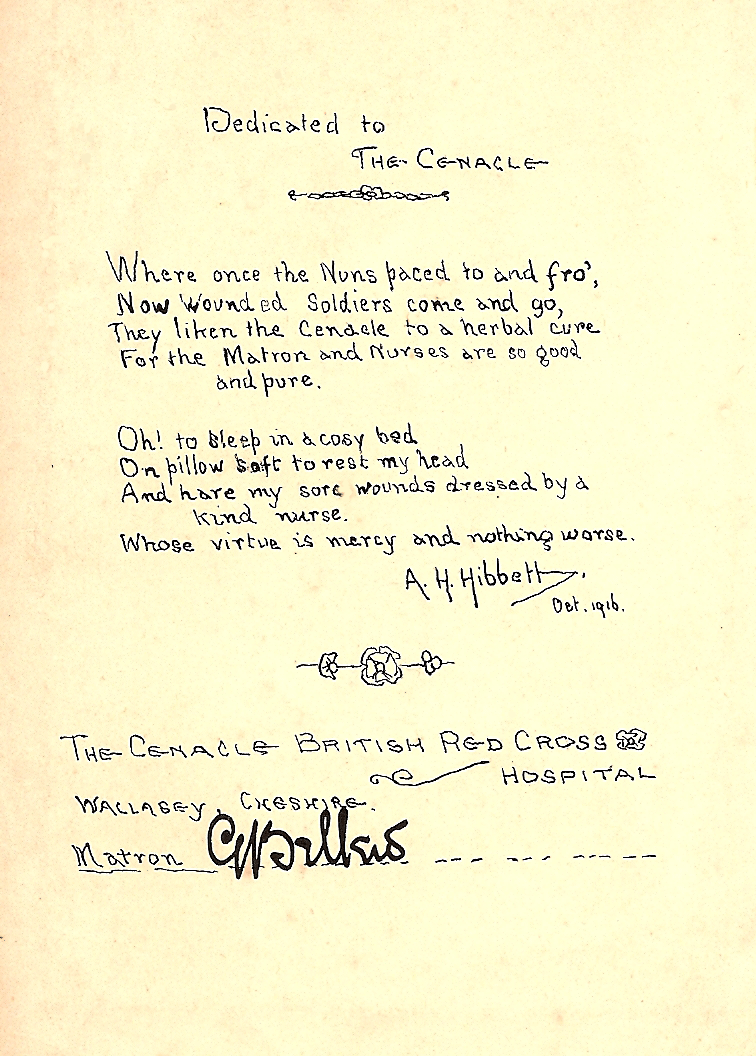
WHERE ONCE THE NUNS PACED TO & FRO NOW WOUNDED SOLDIERS COME & GO.

PROGRAMME:- 

1.  Pte: Farrar H. R.A.M.C.  Pianoforte Solo:  Silver Ruin.

2.  Nurse Greenham.  Song: Had I but known where my caravan.

3.  Pte Kirk E.C. R.A.M.C.  Recitation: The Fireman’s Wedding.

4. Nurse Hay.  Recitation.

5. Nurse Cockeram.  Violin Solo. 

6. Pte: Wallace 23rd London Regt.   Song: Tennessee.

7.  Cpl: Beck Liverpool Scots.  Song: The Trumpeter.

8. Nurse Wilcox.  Song: Michigan.

9  Pte: Hibbett A.H. S. Staffs. Recitation: Sniper Atkins.

10.  Rflm Pays A.F.  Song:  Until.

11.  Nurse Evans. Violin Solo.

12. Pte A. Kelly. South Irish Horse. Song at Piano: Goo Goo Eyes.

13. Nurse O’Neil.  Song: I love the Moon.

14.  Cpl. Featherstone. Durham Light Infantry.  Song: Macafferty.

15.  Cpl. Byrd  C.B. Cold. Guard. Songs: Son of Mine. Shipmates o’mine.

Popular Choruses

GOD SAVE THE KING                                                Oct 4/16.

*****************************

cenacle-4-poem-dedication

Where once the Nuns paced too and fro’, Now wounded Soldiers come and go, They liken the Cenacle to a herbal cure For the Matron and Nurses are so good and pure.

Oh! to sleep in a cosy bed On pillow soft to rest my head And have my sore wounds dressed by a kind nurse Whose virtue is mercy and nothing worse.  A.H.Hibbett. Oct 1916.

*****************************

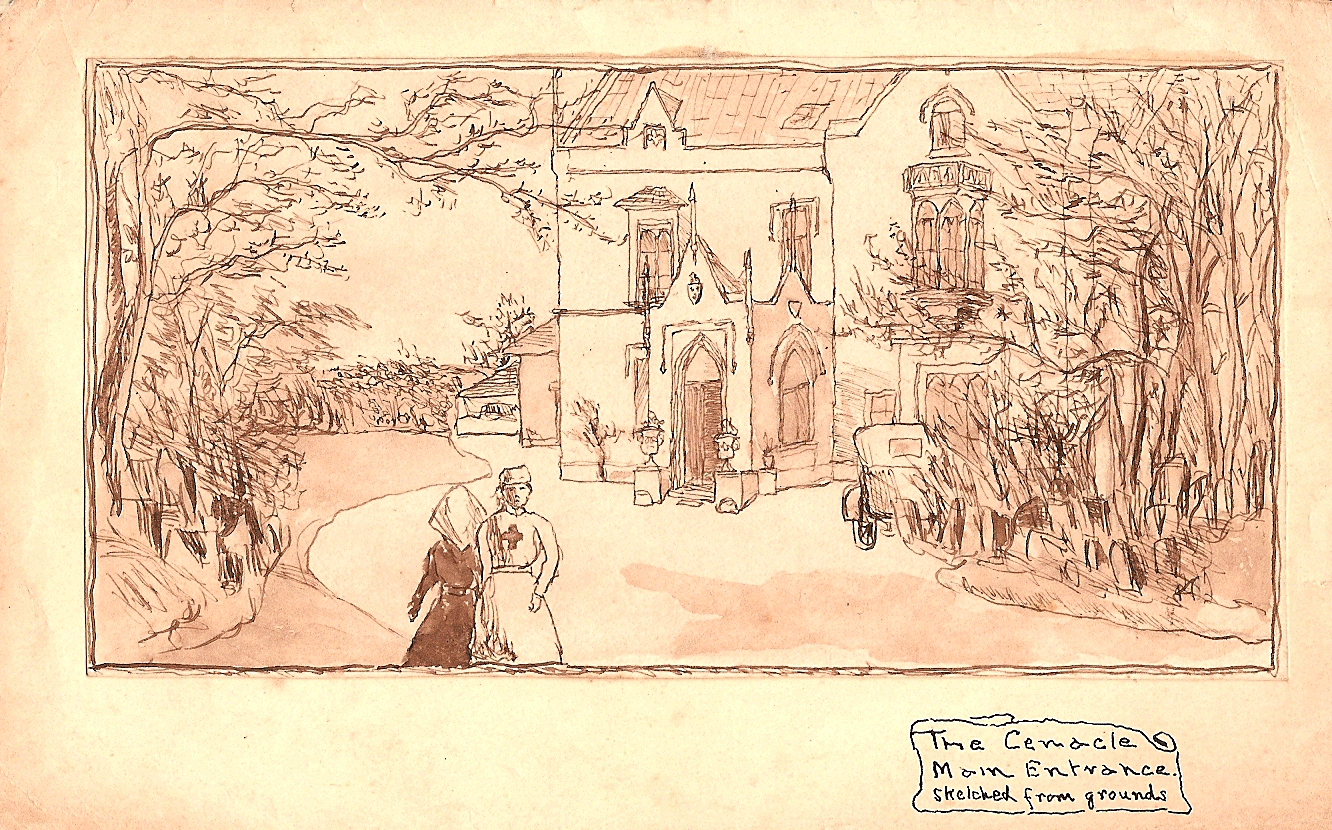
cenacle-5-drawing-front*****************************

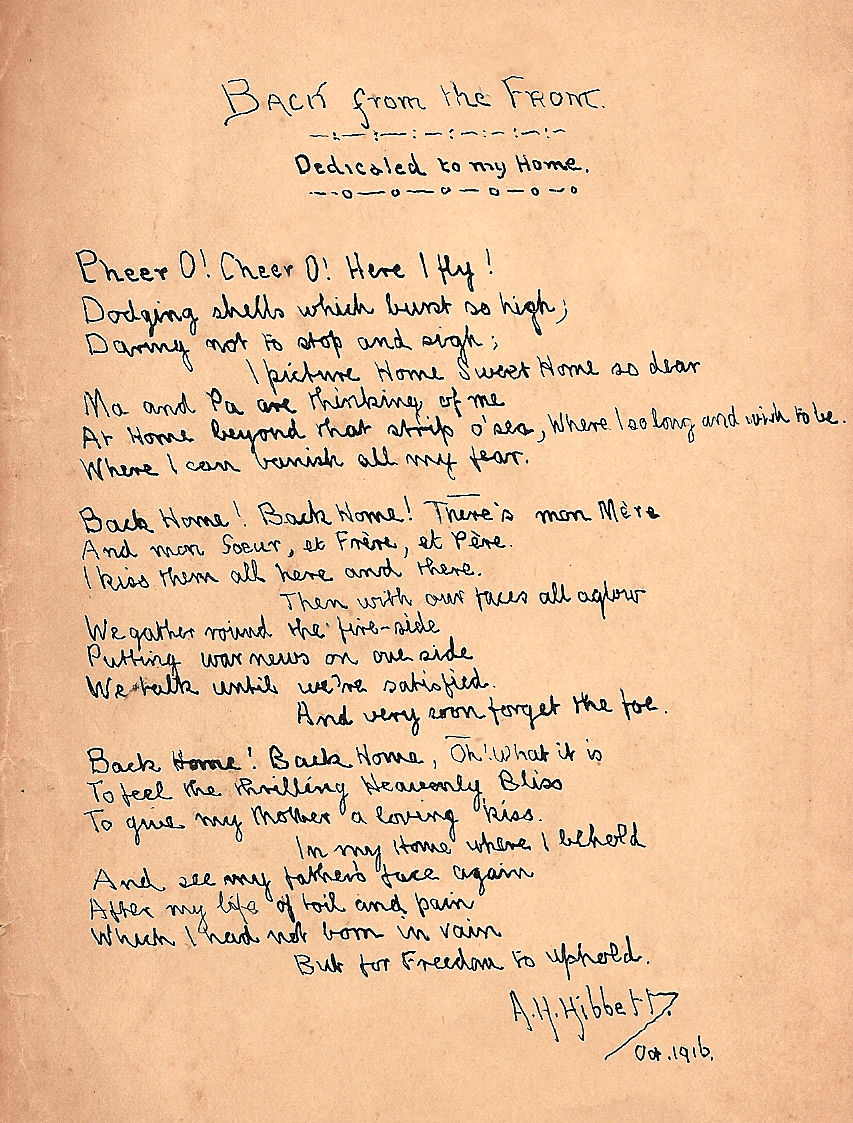
cenacle-6-poem-back-fr-front

**********************

BACK from the FRONT. Dedicated to my Home.

Cheer O!  Cheer O! Here I fly!  Dodging shells which burst so high; Daring not to stop and sigh, I picture Home Sweet Home so dear. Ma and Pa are thinking of me At Home beyond that strip o’ sea, Where I so long and wish to be. Where I can banish all my fear.

Back Home! Back Home! There’s mon (sic) Mere And mon  (sic) Soeur, et Frere, et Pere. I kiss them all here and there. Then with our faces all aglow We gather round the fire-side. Putting war news on one side We talk until we’re satisfied. And very soon forget the foe.

Back Home! Back Home! Oh! What it is To feel the thrilling Heavenly Bliss To give my Mother a loving kiss. In my Home where I behold And see my father’s face again After my life of toil and pain Which I had not born in vain But for Freedom to uphold.  A.H. Hibbett. Oct 1916.

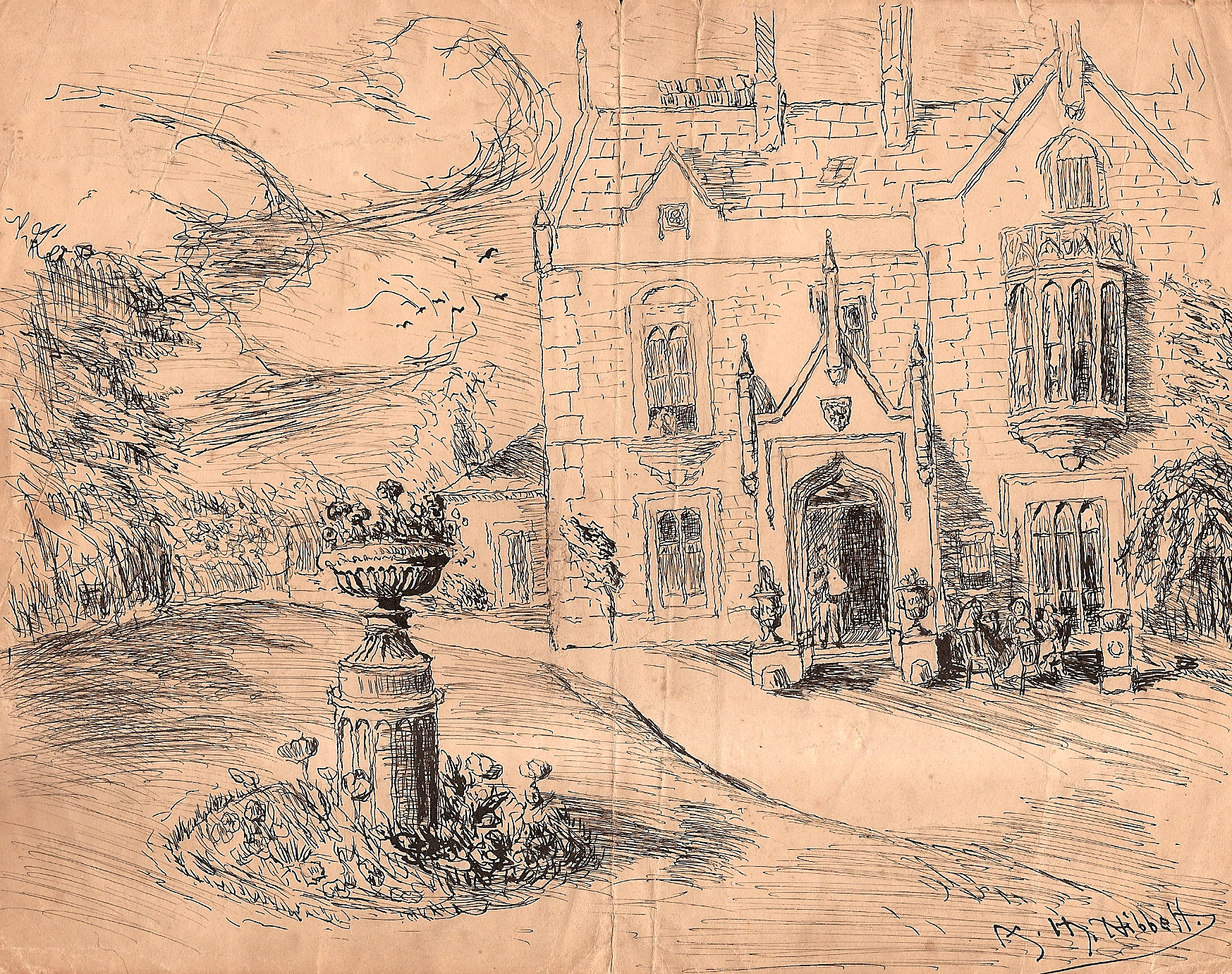
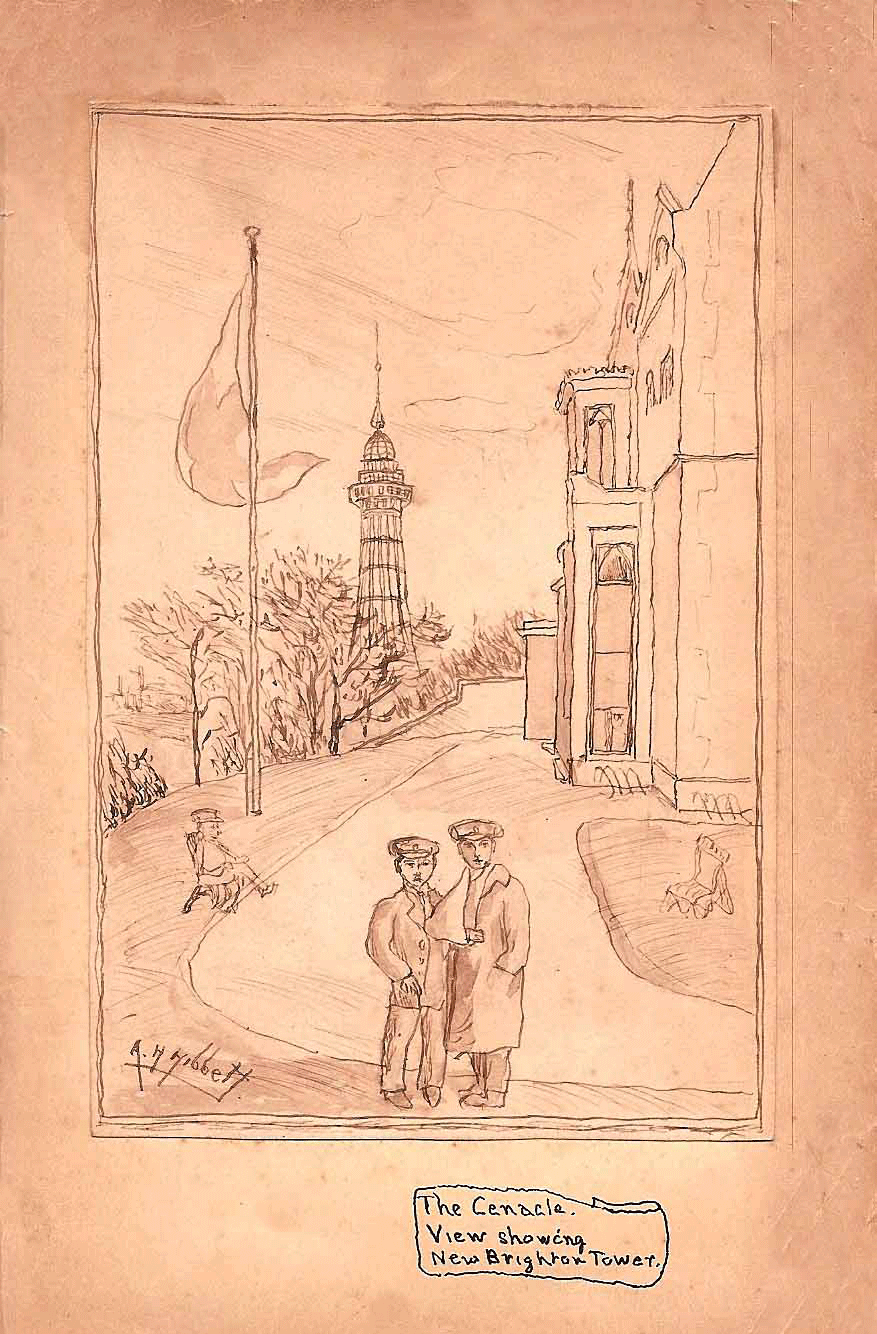
The Cenacle. View showing New Brighton Tower.
The Cenacle. Concert Programme Illustration showing New Brighton Tower.  A.H.Hibbett. 1916. Both The Cenacle & the Tower have been demolished. (See Tower Note below).

***********************

ELIZABETH HIBBETT WEBB

Pte Bertie Hibbett’s Letters from The Front show how much he enjoyed taking part in Army Concerts. He also describes Hospital Concerts given by the YMCA & Red Cross Nurses in France. It could well be that my father had a hand in organising this Cenacle Concert & another given on 10th Nov. 1916. Perhaps he even acted as Master of Ceremonies, as he did later in his College years.

The Programme of Recitations, Songs & Instrumental pieces is typical of Concerts during WW1 and a  good illustration of the talent amongst Cenacle soldiers & nurses alike. No doubt the Matron made sure the content was suitable for a respectable establishment My father’s illustrations, all done with his left hand, are delightful in their attention to detail. The Programme Shield could be that of the Cenacle when it was a Nunnery, but it is more likely one of his own designs – a phoenix rising from the ashes, a symbol of new life. 

THE COMPANY:-

(1) Pte: H. Farrar. (Royal Army Medical Corp). Pianoforte Solo: Silver Ruin. Connection to poem by Robert Burns, 1916? See From the Somme to Silver Tassie. ‘Sean O’Casey & the Contorted Legacy of 1916’ by Edward Mulhock.

(2) Nurse Greenham.  Song: Had I but known where my caravan rested. (Waltz Tune). Listed in Columbia Records Calendar, 1916-1917.

R.A.M.C Autogrphed Cigarette Papers. Red Cross Hospital. 1916.
R.A.M.C  Autographed Cigarette Paper: Pte Ernest C. Kirk, 1916.

(3) Pte Ernest C. Kirk. (Royal Army Medical Corp). Recitation: The Fireman’s Wedding. W.A. Eaton. Romantic ballad of young fireman who saved a young woman from fire & made her his bride.

(4) Nurse Kathleen Hay. Recitation.

Red Cross Nurses: Sonia Langdon & Kathleen Hay 1916.
Red Cross Nurses: Sonia Langdon & Kathleen Hay 1917. 
Signatures
Signatures: Sonia Langdon & Kathleen Hay.April 12th 1917.
Cenacle Red Cross Nurse Cockeram.

(5) Nurse Cockeram.  Violin Solo.

(6) Pte: Wallace. (23rd London Regt). Song. Tennessee.

(7)  Cpl: J. Beck. (1/10th Liverpool Scots). Song: The Trumpeter.1904. Words: J Francis Barron. Music: J. Airlie Dix 1862 -1911.

Corpral Beck
Corporal J. Beck.
SCOTTISH REGIMENTS.
Cigarette Paper Signature: Cpl J. Beck.


(8) Nurse Wilcox.  Song : Michigan. ‘Michigan, My Michigan’ – to the tune O Tannenbaum/ O Christmas Tree. Lyric: Winifred Lee Brent Lister 1862.

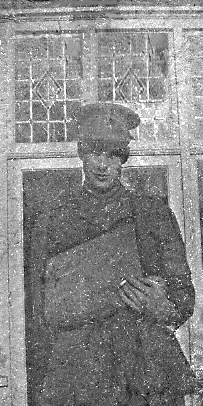
Bertie in Uniform
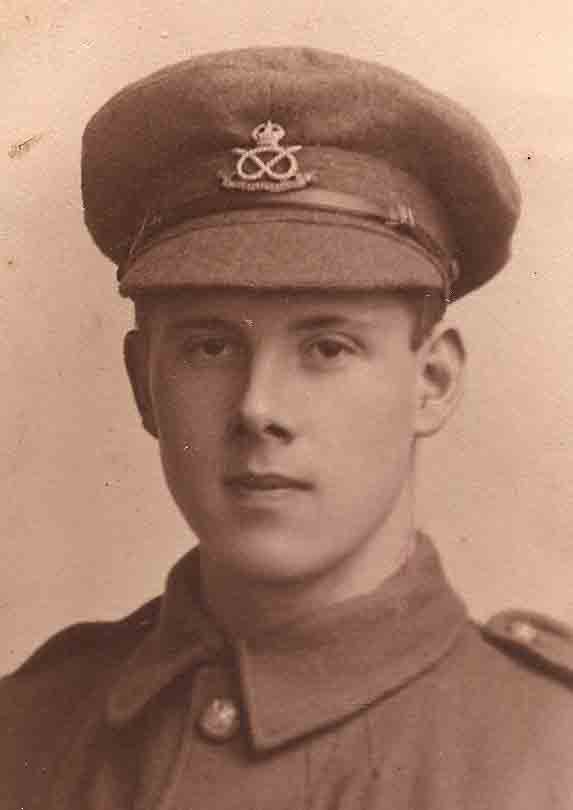
Pte A.H. Hibbett.
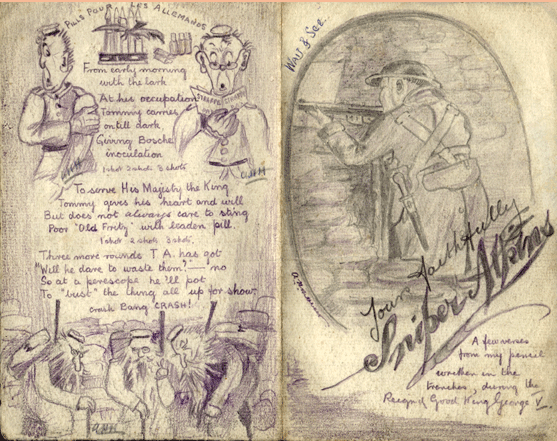
Sniper Atkins outer pages
Sniper Atkins. A.H.H. 1916.

(9)  Pte A.H. Hibbett (South  Staffords). Recitation. Sniper Atkins. Own poem. Foncquevillers trenches. cf Hibbett Letters. May 1916.


Troops Autos & their Cigarettes. THE QUEEN'S WESTMINSTER. South Africa 1900- 1902.
Cigarette Paper Signatures: Rflm A.F. Pays; Rflm G. Hughes & Rflm W.S Markwell. The Cenacle. July 1916. Ward 6.

(10)  Rflm A.F. Pays (The Queens Westminsters). Song:  Until. 1910. Wilfred Sanderson. 1878 -1935.

(11)  Nurse Evans.  Violin Solo.

Pte Kelly.
Cigarette Paper Signature: Pte A. Kelly.

(12) Pte A. Kelly (South Irish Horse).  Song at Piano. Goo Goo Eyes. cf ’19th cent American Black Music’. 1900 hit. ‘Just becos she made dem Goo-Goo-Eyes’ / ‘If you love your baby make Goo-Goo-Eyes’. Phrase exploited by Barney Google, 1923.

Cartoon.
Pte A. Kelly’s Cartoon: The Matron & The Cook. 
Matron Gertrude Bellow
Matron Gertrude Bellow.


(13) Nurse O’Neil. Song:  I love the Moon. Classic Nursery Rhyme/ Lullaby. ‘I see the moon the moon sees me, down through the leaves of the old oak tree, please let the light that shines on me shine on the one I love’. Anon.

(14)  Cpl. Featherstone. (Durham Light Infantry).  Song: Macafferty. Irish Street Ballad. Patrick McCaffrey, Ireland Regt of Foot, born 1842, executed 1862 for killing two officers. Folk hero.

bostock-byrd-turnbull-cigs-sigs
Cigarette Signatures: Corpls: C. Bostock Byrd & H. Turnbull R.E.

(15)  Cpl. C. Bostock Byrd. (2nd Bn Coldstream Guards).  Songs:  Son of Mine. Shipmates o’mine. Wilfred Sanderson.1913.

Corp. Bostock Byrd.
Corp. C. Bostock Byrd.

****************

NB. All the material posted here comes from the Hibbett Collection of Photographs, the Concert Programme and my father’s 21st Birthday Autograph Album given to him by his best pal Vernon Evans. Details of the Cigarettes are given elsewhere in the Hibbett Letters.   

New Brighton
New Brighton Tower.

New Brighton Tower: steel lattice observation tower 567ft high, opened 1898 -1900 as part of a Pleasure Park. Dismantled 1919 except for Tower Ballroom (Beetles venue when not at The Cavern Club) – finally closed 1969.

NEXT POST:  12th Oct. 1916. Our brother has gone to that peaceful land where there is no war.’

OCT 1916 : BACK FROM THE FRONT.

Pte BERTIE HIBBETT, The Cenacle, Red Cross Hospital, Wallesley, New Brighton, Cheshire: ‘BACK from the FRONT’.

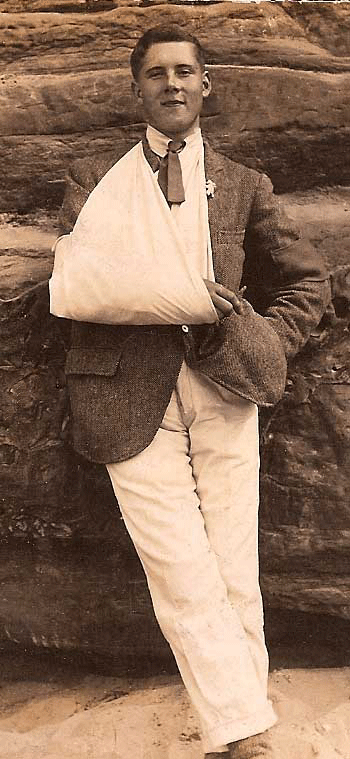
This Poem, possibly begun in the trenches, was finished in the Red Cross Hospital ready for the October Concert Programme. It indicates that my father was allowed Home to Walsall about this time in 1916. This is supported by a photograph of him in uniform with his arm in a sling & my Dad’s caption:’Possibly taken at 95 Foden Rd Walsall’, added in 1960s. 

bertie-uniform-sling-early-in-hospital-red-crsoo-new-brighton

Dedicated to my Home

Cheer O!  Cheer O! Here I fly!

Dodging shells which burst so high;

Daring not to stop and sigh;

I picture Home Sweet Home so dear

Ma and Pa are thinking of me

At Home beyond that strip o’sea,

Where I so long, and wish to be.

Where I can banish all my fear.

*********

Back Home! Back Home! There’s ma Mere

Et ma Soeur, et Frere, et Pere

I kiss them all (both) here and there

Then with our faces all aglow

We gather round the fire-side

Putting war news on one side

We talk until we’re satisfied,

And very soon forget the foe.

**********

Back Home! Back Home!, Oh what it is

To feel the thrilling Heavenly Bliss

To give my Mother a loving  kiss

In my Home where I behold

And see my father’s face again

After my life of toil and pain

Which I had not born in vain,

But for Freedom to uphold.

A.H.Hibbett Oct. 1916.

ELIZABETH HIBBETT WEBB

I published this poem too soon by mistake hence the quick update!

NB My father’s French has not improved!

NEXT POST: 4th Oct 1916: The Cenacle Red Cross Hospital Concert.


19TH SEPT: ‘BERT, WHAT MAKES YOU THINK ABOUT BARBED WIRE NOW?’ YOUR OLD PAL BEN.

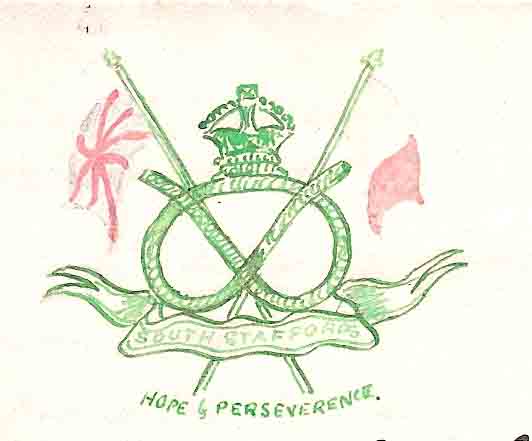
South Staffordshire Badgee
South Stafford’s Knot Badge: ‘Hope &  Perseverance’.

YOUR OLD PAL BEN, 1/5th South Staffordshire Regiment at the Front: LETTER to Pte BERTIE HIBBETT, The Cenacle Red Cross Hospital, New Brighton, Cheshire.

Field Post Office 152    Censor L. J. Taylor.

                               Sep. 19th  1916.

Dear Pal Bert,

I was very pleased indeed to get a letter from you so quick and it gave me such a surprise when I opened it and saw your photo (1) a straw would have knocked me down in the trench.  Reg Taylor * fainted when he saw it.  He said to me ‘Ben, he has got some swank on him now, with his ring on and a cigar in the same hand’.

Bertie
Pte Bertie Hibbett.  Aug.1916.

Bert we are having a very pleasant time where we are. I think we have frightened them just where we are holding. We have had the pleasure of catching a few of them since we have been at that part.

I hope by the time you get this letter you are better in health and look better.

Bert I was so proud of the five fags as I was smoked straight out and they made me a very comfortable night.

What do you mean Bert that you like my style of writing.  What is it like –  a young lady’s style? (2).

Yes Bert, I think myself that you had had enough – and also myself, don’t you think so, Bert. I am A.1. myself and ready for them any time they have got the mind to come over.

Serj. SydneyI was very sorry indeed when I read your letter and you said that you had wrote  (about Sydney) to the N.M. Div. Base (3) and had it returned back to you, but you may get some news, I say Bert, better late than never.

There is one above who knows where he lies at rest.

I say Bert it was a very hot 1st of July.  I shall never forget Derby Dyke (4).

Cheveaux de friezes. Barbed wire entanglement.
chevaux de frises: barbed wire entanglement.

Bert what makes you think about barbed wire now you have got a contented mind and you are so far away from the Boss (i.e. ‘Bosche’).(5)

Venables* is a prisoner in Germany (6).  J. Maley* is with us now and in the  pink. Yes I have heard about A. O. Jones* being in Blighty (7).  I say it is luck.

I may see some of the old faces shortly as they say we have got a big draft at the Base (8) waiting to join us.  It is very seldom I see Pte Gurley* (9) now as he stops at Head Qrs.  I shall see him when I get out of the line and I will show him your photo and letter.

D. Ball* (10) has left the Batt. some time now, he has gone back under age.

I now close and more next time.

I remain your Old Pal,   Ben.

Write back Bert.

Bert – let me know if you move and send your address.

***************************

ELIZABETH HIBBETT WEBB

More evidence of the many letters my father wrote in the search for his brother and the whereabouts of his friends. I would love to know more about his ‘old pal Ben’, he sounds such a cheerful lad but without a surname to go on this will be very difficult. He was probably in my father’s ‘A’ Coy if he was in Derby Dyke trenches facing Gommecourt Wood, on 1st July 1916. 

Well might Pte Bertie Hibbett be haunted by barbed wire. Not only did he have to face the possibility of being caught on the German wire if he managed to cross No Man’s Land but he also had to carry his own chevaux de frise along the flooded Derby Dyke to the Front Line (700 yrds or more). In his Memories of the First World War my father describes how impossible this was under the relentless shelling. A detailed description of Derby Dyke on 1st July 1916 is given by Alan MacDonald in A Lack of Offensive Spirit? p 348.

(1) Pte Bertie’s Photo: probably one taken by Harold on the beach at New Brighton, Aug/Sept. 1916. (2) Writing Style: perhaps Bertie had teased Ben about his conversational repetition of ‘Bert‘ in a previous letter. (3) 46th N.Midland Division Base: Rouen.

(4) Derby Dyke: 1/5th S. Staffords Assembly Trenches, Foncquevillers, Battle for Gommecourt, 1st July 1916. One of the principal communication trenches named after the Division ( Staffords Avenue, Lincoln Lane, Leicester Street, Nottingham Street, Derby Dyke, Roberts Avenue, Rotten Row, Regent Street, Raymond Avenue & Crawlboys Lane). Derby Dyke ran through orchards at the edge of the village parallel to Nottingham Street & the modern road into Foncquevillers. These trenches had been deepened from 2 ft to 7 ft in the lead up to the Battle and on the day were full of water. Derby Dyke held the ‘Advanced Battalion HQ of the right attacking Bn in the right brigade’.

(5) Barbed Wire: See My Memories of the First World War ref to chevaux de friezes/ barbed wire contraption my father was desperately trying to carry through the trenches on 1st July 1916. (6Arthur Venables*: Missing on 1st July 1916 after he had dressed Pte Bertie’s wound and saved his life. It was possible but I think an unlikely hope that Venables was captured that day. Commemorated on Thiepal Memorial to the Missing & Walsall War Memorial.

(7) Corp. A.O. Jones: the Hibbett family was anxious to trace Sydney’s pack & belongings, which in his last letter he said he was entrusting to his friend Jones ‘in case’. If Corp Jones was wounded & back in Blighty that would account for the lack of news, especially as the Battalion had moved to a different part of the Line on 2nd July.

(8) Base: Rouen. (9) Gurley*: my father had also written to Sergt Price about Gurley. See Hibbett Letter: 17th Aug. 1916. (10) D.Ball*: younger brother of Sydney & Bertie’s pal Ball. He appears to have been with the S Staffords in 1914, so very much under age if he was still under 18 when the Military Act 1916 caught up with him.

NEXT POST: 4th Oct. 1916. Soldier’s Concert at the Cenacle, Red Cross Hospital, New Brighton.